Tampilkan postingan dengan label pagaran. Tampilkan semua postingan

Rabu, 11 Juni 2014

Traditional Building


Book Review MENGENALI BANGUNAN SERTA ORNAMEN RUMAH ADAT DAERAH MANDAILING DAN HUBUNGANNYA DENGAN PERLAMBANGAN ADAT (IDENTIFYING AND ORNAMENTS HOUSE BUILDING COMMON AREAS AND CONNECTION WITH SYMBOLISM CUSTOM MANDAILING) By Drs. Oloan Situmorang

Reviewers
Cut Nuraini Fadli

INTRODUCTION
Books written by Oloan Situmorang consists of five chapters, the first introduction, includes four sub-chapters: introduction to the problem, the importance of traditional buildings are maintained and preserved, the scope of the problem as well as the purpose and benefits; both traditional building heritage, includes three sub-sections: the meaning of traditional buildings, building elements of the personality and customs as a symbol; The third area of ​​building custom Mandailing, includes three sub-chapters: the deployment location, type of building and its function and structure of the building; The fourth meaning and decorative elements in the custom home building Mandailing, includes three sub-sections: Background to the decoration, decorative type, aspect of behavior in the form of a symbol on decoration; The fifth aspect of the behavior of the application.

BOOK SUMMARY
Indonesian archipelago has a wide variety of cultural background of the local tribes. The cultural diversity characterized each region in accordance with the conditions of the people who inhabit it, there is still characterized by traditional and some are still primitive. The rich diversity of Indonesian culture which is widespread in some areas have a high aesthetic value. Cultural diversity is clearly depicted by each tribal areas of the archipelago which has a strong cultural tradition and distinctively different regions according to state and tribal communities that have been passed down through the generations by their ancestors. One of the local culture that can be expressed through writing is a form of traditional building custom building.
Building custom as a form of traditional building is a building that is large accompanied by specific patterns and different from the local community building. Likewise among regions, each showing its own identity. Custom building as a national cultural heritage should receive special attention in order to preserve the nation's cultural heritage as an asset. Therefore, it is necessary internalized the meaning contained in the customs buildings, one of which is building custom Mandailing area located in the Level II South Tapanuli, North Sumatra. Preservation and maintenance of custom building is important that local traditional order of life is not lost, so the inheritance chain of indigenous noble values ​​to the younger generation is still running.
Writing this book aims to discuss and outline the structure of traditional Indigenous mandailing, including the meanings associated with elements of the building and decoration, and its relation to society personalities. Hopefully, this discussion can contribute in the excavation area Mandailing traditional cultural heritage.
The formation of traditional building area is due to the needs of the tribe or clan groups who want to create a social bond in the form of a sense of community, a place to consult for the good of the tribe through a container that is custom building equipped with all means of customs and perlambangannya. Traditional building is defined as a container that is still bound to the old habits, which for generations has not changed.
For Mandailing local communities, the principle of order of life is inseparable from the customary depiction. Mandailing community has a personality that is high in relation to customary behavior, social relations between the members of the clan and inter-community relations. Relationships are depicted in multitudes of indigenous symbols of pictures patterned decoration humans, animals, plants and objects are modified in such a way to use up to form symbols.
Traditional indigenous building number 25 Mandailing existing buildings and spread across three districts, namely Kotanopan, Penyabungan and Muara Sipongi. Traditional building in the district of Muara Sipongi Kotanopan and owned by the Lopez clan groups in the district Penyabungan while building owned by Nasution clan groups, according to the regional spread of the clans in Mandailing.
Mandailing custom home building structures have differences due to the shape of different house sizes. There is a large custom home building, that Bagas Godang the possibility once the first building built by the Raja Huta after a village was built, and there is also much smaller: Sopo Godang as customs hall and arts ceremony. There is also another building whose roof resembles Bagas Godan , which houses Kahanggi, Mora and Anak Boru and its function as a place to live.
Roof forms Mandailing custom home is "curved roof" (silingkung Dolok parcucuran) and "flat roof" (saro tole). Not all homes may use these roof forms, except the buildings belonging to the “kerabat raja” ("kin king"). Custom home building structure not unlike the ordinary home, it's just building larger custom sized and fitted with ornaments associated with certain symbols.
Mandailing custom home building structure consists of five parts, namely the roof, body, poles, ladders and experience. Roof pattern consists of two features, namely saratole (flat roof) and silingkung Dolok parcucuran (roof arch). Arrangement of space in the custom home building is made up of several parts, namely (a) Pantar tonga (living room) that serves as a living room, a gathering place for families, special events such as custom hearing, the trial horja (attended by the villagers) and is entitled to use by hatubangon ni Huta and Namora natoras; (b) Master bedroom (specifically for Namora Natoras and her children; (c) Parangin-angin (front room) used by Namora Natoras and family and the gatehouse guard (ulu balang), (d) Hauan Halang (forbidden room) king is offering space to the Mulajadi Nabolon and also as a storage heirlooms, as well as space (e) Parsimonjapan (hiding space) as protection from the pursuing enemy space. latter space is not available in all Bagas Godang. Sopo Godang only have two rooms , ie Pantar na alternating (deliberation room) made an open, limited only high wall 0.5 s / d 1 meter and storage cubicle space objects wear, custom art tools and equipment.
Pillar-shaped sculpture on building custom rectangular and octagonal. The composition of the poles varies in accordance with the building area, but always use odd numbers 3,5,7,9. The odd numbers are also used in building custom staircases, although the number is still different in each place. Bagas Godang has 7 steps, while the king's relatives homes have 5 steps. The houses are the usual number of the steps 2 and 4. Stairs in custom home Mandailing called sibingkang wooden staircase, which climbed the ladder if it will cause a crackling sound. The creaking stairs signaled to the household, that there are guests who come.
Pages on custom building has an area of ​​diverse, there are extensive and there are narrow. The function of the page is the place to implement the various activities related to customs. At the present time, increases function, namely as a Gordang Sambilan arts, martial arts training, dance training as well as celebration of Islamic holidays.
Each building has a Mandailing customary in the form of a decorative ornament in certain parts. Creation motifs ornament as a sign of the existence of a customary starting huta who have had custom completeness and legal regulations that have been agreed upon fixed and hearings through customs. Customs as a permanent source of law should be known by every citizen and immigrant, which was made in the form of signs letter of images from each of the diverse customs by panggorga (arts expert). The custom symbols using motifs of plants, animals and objects as well as shown by a combination of three colors, namely red, white and black.
Decorative types that include numbering 33, are (a) jagar-jagar, denoted by coconut pistil is still small, which means huta bona feathers have strong traditional institutions; (b) bindu, bamboo shoots form a meaningful picture of people's lives is the basis dalian Natolu; (C) timbangan, the symbol of justice and truth; (e) gancip, a sort of clamp that can be cut significantly and the king should hold customary law, implementing the truth; (e) barapati, dove after every meaningful for a living, had to return home; (f) takar, coconut shell means any distress panga, can ask for help to the king and rural communities; as well as several other symbols.
All the elements of decoration or part of the building is a symbol of personality. The definition of personality is an aspect of behavior that is always expressed in the attitudes and actions everyday. Some aspects of behavior in the life bermasyarakatnya shown through symbols speak ornament is customary greetings, airy and open heart, brave in truth, helpful, ungrateful, honoring guests, are social and always consulted consensus. Based on the behavioral aspects that reflect the personality, enough to prove that local communities have the authority Mandailing high and honorable and generous nature. The emergence of such a personality is not out of the teachings, instructions and guidance of customary provisions that have been created by older people and their ancestors, and for generations passed down to posterity as the next generation.

DISCUSSION
Traditional building heritage, often interpreted as a building that has special characteristics and different forms of other residential buildings. The hallmark of this building is shown in the form and larger size and enriched by decorations that have meaning as the customary order of implementation of the social life of the community. Therefore, the privilege in this traditional building is its ability to provide information about what things it contains by symbol-indigenous symbolism. This phenomenon is actually a habit of any building that serves as a traditional building. The ability of each building in informing what they contain so-called linguistic analogy semiotic phenomenon, which adheres to the view that something is a sign of a building consisting of information delivery usur elements are laid out according to the rules, allowing people to quickly understand and interpret what is conveyed by the building.
This book studies in early-onset literary emphasis on the importance of protection and attention of all parties to the indigenous architecture Mandailing. This is confirmed by the author through the three reasons the importance of preserving architectural Mandailing, namely (a) the meaning; (b) the element of personality and (c) symbol. Meaning I think includes some things, namely that the first custom home is a process in which each stage pengerjaannnya has its own meaning. Building a custom home is not just making foundations, pillars, roofs, walls resulting in the need for shelter are met, but rather the fulfillment of specific requirements at any stage before the process. Although the house is habitable, but certain rituals still remains to be done. Second, traditional buildings as heritage buildings or enlightening that architecture is an element of culture that has grown and developed into a container that doubles as a shelter in the true sense and as a form of expression of the user's desire. Personality is an underlying attitude of a person's behavior and attitude is the unity of a group of people or a group of people, which was based on a public private manners and mores of everyday social behavior, and developing mutually integrated. When the identity of the attitude has been fused to each other within each individual, then formed a joint agreement to abide by them. In the end, the meaning and the personality will become a symbol in the society.
Studies on the Regional Indigenous Building Mandailing (p.24) in the three chapters of this book, as they appear in the book Mandailing: History, Indigenous and architecture, works of M. Dolok Lubis (p.50). However, the book written by Oloan Situmorang equipped with custom tabulation building deployment in Mandailing. What is interesting in the discussion of the structure of the building by Oloan is a description stating that "a large custom home building which presumably is the first building built by the king Huta after a village built" (p.27). Doubts have missed the fact that studies have been done several times, that the king even when a village has been built to survive as indigenous Huta. In Mandailing, huta yet 'mangadati' not entitled to Bagas Godang establish. To become a huta which has a complete custom, there are requirements that must be owned by a huta.
Here is the inception of huta elements in the review of aspects of the physical and non-physical, based on the research I did.
Therein lies the uniqueness Mandailing truth, that the customs building and other elements in huta truly an important architectural process that is implied in the process so much meaning. In fact, to open a new huta, also requires a certain process with a sequence or a sequence that is highly structured.
Topics on other structures in Oloan book is a page, which is not appropriate if the structures are grouped in discussion. Pages may be appropriate are discussed in the context of its own as one of the micro-architectural elements. Pages in Mandailing known as Alternating Alaman Selangseutang not just a vast expanse of land in front of Bagas Godang. This page is one of the important architectural element for the formation of Huta in Mandailing.
The process of forming a customs huta in Mandailing has two important phases, ie Pagaran be huta and Huta became customary Huta. Pagaran be huta, the stage marked the opening of a village with houses built in and work together to put the residential buildings in the zone Banua Partonga. The development of residential buildings in Pagaran into banjar and subsequently formed a huta group stay abreast of existing buildings in the zone. Huta become customary Huta, the inauguration stage huta who already has a full custom devices become customary through horja Huta Huta further development begins with determining the location Alaman Alternating and main buildings. Experience and Sopo Godang placed on Banua Partonga of Bagas Godang while stationed in Banua Partonga zone, close to Banua Parginjang. Bagas Godang orientation sought not to the sun, but to the sun position is better than having to be at Banua Partoru zone.
Determination of the location of a physical object or place any building or non-building based on three important aspects of the well as a hierarchy, namely (a) the concept Banua, (b) the belief system associated with the river and the power of the sun and (c) natural conditions. First, place a physical object is determined by the appropriate zone, then the orientation is determined by the location of the river and the position of the sun. If the natural conditions do not allow, the orientation can be changed, but still not far from the river and not to the sun. So in this case, the application of the concept Banua layout and orientation of the river is very consistent, while the sun's belief in the power system is highly dependent on natural conditions.
Huta formation process in Mandailing through two stages showed a trend toward the possibility that the community has been estimated or predetermines the location and position of Alternating Alaman in the newly established Huta. In this case, estimates or determination of the location of Alaman only for a while until in penuhinya be huta customary terms, so that in the subsequent development, the location of the planned use within alternating Alaman is not disturbed or guarded so as not to set the building on it. When formed huta customs and land needed to Alaman Alternating with customary buildings, the land has been estimated and planned since the first was opened and built Bagas Godang and Sopo Godang around.
This phenomenon may be related to Lobu. Understanding Lobu has two different meanings in the Mandailing community. The first sense, Lobu is a land that was first opened and was found by village founder, when he discovered a new area near the river which will be developed into Huta. Areas that can be used as settlement land is nowhere near a river called buts so marlinta na, na so marongit jalangan which means buts or places that are not inhabited by leeches, uninhabited prairie mosquitoes. Clearly, the place is a comfortable, healthy and without disease.
Lobu the newly opened fields are only used as a visit at any time and built some of Sopo field for shelter. After farming activities and bersawah completed, then the population Lobu leave and return to his native village. This continued until they have a solid home village and the area needed for the new village. At this stage, Lobu began to be developed into a banjar and Pagaran. When it became huta, then Lobu area that was originally used as a temporary field being used as Alaman alternating with the buildings.
Understanding Lobu second is the origin of the settlement area has been turned into a burial ground. If seen Lobu this second sense, it may not be the opening of the Lobu alternating Alaman, because the land is not suitable for placement funeral Alaman alternating as custom activity center in Huta. Understanding the first Lobu more relevant for answering phenomenon Alaman locations in huta that seems to have been first planned. Understanding the Lobu, in addition to being at a location adjacent to the river is also used as a field which is the place of human labor activity to continue his life. In this case, Lobu certainly be at Partonga Banua zone, the central area of ​​human activity in everyday life.
It also raises new questions about the existence of abstract concepts in thinking about huta Mandailing people who apply the concept of cosmology three Banua and always carried by them when going to look for new land settlement. Chances are Mandailing community has mapped out the concept in mind and manifestation of the concept will gradually be seen clearly if a huta have really stood out. However, it is of course still the allegations that require confirmation and further research, because it has not found any data and facts that can explain the phenomenon.
Last on this book I did directly on the last topic, the application of behavioral aspects, because Oloan Situmorang discussion about the structure and the exact same ornaments made by M. Dolok Lubis. Studies on the behavioral aspects of this application, as further confirms the issues that always makes people's hearts Mandailing be sensitive, that is not Batak Mandailing. This issue until now is no longer a secret, but it continues to be discussed by the Mandailing community, which from the beginning do not want to be regarded as 'Batak'. According to the sacred stories of the people, especially the Batak, all sub Batak tribes that have a common ancestor, ie Si Raja Batak. However, people Mandailing stated that their communities instead of 'Batak' as it is known for a lot of people. Since old people do not want to be called as Batak Mandailing people. They gather a lot of evidence that suggests that people with different Batak Mandailing people. Some evidence in the form of data and research on the origin of Mandailing further strengthen the confidence and gave birth to a new statement saying that in fact the Batak people who exist today actually comes from Mandailing. The data used as evidence that the inaccuracy of information, including the Batak Mandailing are (1) Tonggo-tonggo Siboru Deak Parujar of the Toba; (2) CANTO 13th Negarakertagama poem by Mpu Prapanca; (3) Dalian Natolu Indigenous; (4) Language and Literacy Mandailing; (5) Gordang Sambilan. Despite the fact regarding whether or not a difference of opinion about Mandailing people who do not want to be called as the Batak, Mandailing interesting to study because there are many very condition of cultural significance has not been revealed, one of which is on the river as one of the elements huta allegedly had a big hand in structuring patterns huta space overall.
In the end, a strong personality in the society has made their Mandailing have forward-looking view of life. Implementation can be seen in Mandailing progress achieved in all areas, namely regional development, spiritual development, education and teaching as well as tourism. Similarly, the field of art and culture. The mission is one of the cultural progress of society demands Mandailing, so the area Mandailing culture alive throughout the ages.
Posted by Cut Nuraini Fadli.


~0~

Senin, 20 Januari 2014

Kotanopan: The Land of Fredom Fighters

=====================================
KOTANOPAN: A 'HUTA' (' NEGERI ') 
IN SUMATRA ISLAND, MY BIRTH PLACE WHERE TO GROWING UP
=====================================

According to the stories I've heard from a number of people who have aged old enough in ‘Kotanopan’ (around 1980), that the naming of the ‘negeri’ Kotanopan was initially originated from the word 'Huta Panopaan', then evolved into 'Huta Nopan', and eventually became the 'Kota Nopan', but the name of the ‘negeri' Kotanopan in the northern part of the island of Sumatra is often also written by attaching the word 'Kota' and 'Nopan' ie 'Kotanopan', that's where I was born to grow up.


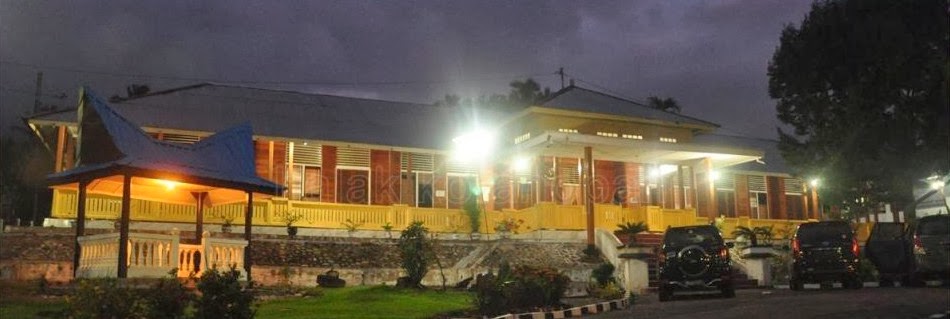
My father (H. Armeyn Nasution) is a 'civil servant' (called 'karsip') who worked in a 'military army office' ('called 'Koramil') in ‘Pasar Kotanopan’, is trade center in Kotanopan (whitin Mandailing Julu region). Because my father worked in the military office, he was given a 'home office' is located not far from his office, which is a Dutch heritage house called 'Gudang Garam' that was once used as a storage 'salt' in 'Banjar Kuliling' in ‘Pasar Kotanopan’, which is not far from 'Pasanggerahan Kotanopan', is a historic place in our country. Since the first in 1948, the first President of the Republic of Indonesia, Sukarno, was never addressed at the event 'Rapat Akbar' for the socialization of Independence and the invites all residents Sumatra to maintain independence. When Sukarno speech standing on the steps of the house by the Dutch (‘Pasanggerahan Kotanopan’), which was built in 1930. The rooms where Bung Karno (Soekarno) stay when it is now made ​​into rooms 'number one' (No. 1). Photo of Bung Karno while addressing the ‘Pasanggerahan Kotanopan’ ladder mounted above the entrance to the living room Pasanggerahan. Under the picture it says: "Presiden Soekarno berdiri di tangga Pesanggrahan Kotanopan ketikaberpidato pada rapat raksasa di Kotanopan 16 Juni 1948". Presence of Sukarno in Kotanopan (1948) is to calm the turmoil and unite people in Sumatra who want their own independence when it.
In addition to being a place 'mammoth rally', in front of the building that was once used as a 'mess Dutch soldiers' (Pasanggerahan Kotanopan) is, now there is also a Pioneer Independence monument large enough. On the fourth side there is an inscription containing the ‘Proclamation text’, ‘preamble’, information about the monument, and some names heroes who died defending freedom. But actually there before becoming a hero is a small monument in the courtyard Office Assistant district officer (now called ‘Head Office’), on the edge of the turnpike Medan-Padang. And when we entered the living room Houses were also displayed image Gen. Abdul Haris Nasution (Pak Nas). Famous people born Kotanopan indeed, precisely in HutaPungkut. Although using the word 'City', but 'Kotanopan' actually just a district that became part of the district Mandailing-Natal ('Madina'), North Sumatra Province, Indonesia.
Not far from my house ('Gudang Garam') flowing river 'Batang Gadis' which is quite large and heavy, and in certain parts of the water is deep enough (so-called 'lubuk') like 'Lubuk Gala-gala' (in 'Banjar Lombang'), 'Lubuk Kandang Kudo' (in ‘Jambur Tarutung’ or ‘Banjar Narako’), and 'Lubuk Jorbing' ( in ‘Pasendeng’). It may be said almost every day we were bathing in the river 'Batang Gadis' and together with each other peers 'pitted dexterity' in 'lubuk-lubuk' as to who the fastest swim across, most durable dive, throw a stone farthest on the surface of the water, climb trees and run 'putty' to pluck unripe fruit (called ‘mutik’) to eat. Not infrequently (usually on a Saturday or Sunday), before showering together and having a good time jokes in 'lubuk-lubuk’, we go a little further into the river upstream. There, we then cut down banana trees to be used as a boat (called 'rakik') and anchored in one of the 'lubuk'. After being bathe in the 'heart' that, then we stop and return to their homes. Arriving at the house, it is not uncommon respectively scolded by our parents for being too old bath (called 'margambur') in the 'lubuk-lubuk' at ‘Batang Gadis’ river.
Kotanopan has a hilly geography, and therefore the cool weather. While the 'Batang Gadis' river flowing through the Kotanopan used by nearby residents for irrigation, search stone, sand, gold panning, and that is quite unique, which makes "lubuk larangan" as 'social capital', the proceeds of which, among others, to finance the ‘Madrasah’ (religious) school teachers .
'Lubuk larangan' is a Watershed (‘DAS’) which is used for the management of catchment population of fish in the Watershed (‘DAS’) is regularly discussed according to the law surrounding community, be it the boundaries of 'lubuk larangan', violations of rules and past or future opening of their fishing to the public. ‘Lubuk larangan’ of this prohibition is opened periodically, usually during periods of ‘Idul Fitri or ‘Ari Rayo’ (Eid). ‘Lubuk Larangan’ are usually named after the place through which the river settlements 'Batang Gadis' is. For example: 'Lubuk Larangan Singengu', is 'lubuk larangan' located in Singengu. The 'lubuk larangan' another is 'lubuk larangan Lumban Pasir', 'lubuk larangan Huta Baringin', 'lubuk larangan Tamiang', 'lubuk larangan Huta Pungkut', 'lubuk larangan Muara Soro', 'lubuk larangan Tadangka', and the other.
I was born in the house my grandfather (named Lobe Karim Nasution) at his request. My grandfather's house is located in a place of settlement called Gunung Tua - Muara Soro in Mandailing Julu district. Adjacent to the birthplace 'Banjar Pining' where there is the ‘Demang Kurinci’ (‘Demang Kerinci’) is the father of a senior journalist Mochtar Lubis. At Gunung Tua - Muara Soro, social standing by my grandfather existing social stratification, is ‘bayo-bayo na  godang’ ie as ‘anak boru’ of the ‘raja’ (king). A few days later, I brought my parents back home in ‘Pasar Kotanopan’. My home is right at home behind a bloody Chinese watchmaker named ‘Si Gomuk’ (a nickname given by the people Pasar Kotanopan because the Chinese is that it works as it was ‘clock repair man’). In addition, at the residence of Si Gomuk it is also a 'photo studio', which was also visited by people crowded to take pictures (called 'markodak'). Her children were the male is named ‘Si Ombun’, ‘Si Loun’, ‘Si Kibun’, while women include, ‘Si Emma’ and ‘Si Uk lan’. All the children had been mated with native Mandailing Julu. Among the children of China's family (if not one of them clan or ‘she Bun'), is a childhood playmate ‘Si Kibun’ because our peers. On the day of week (Saturday), my friend's house is always crowded by people who come from different of settlements' (ie 'Pagaran', 'Banjar', 'Lumban', and 'Huta') in the area ‘Mandailing Julu’ to repair the clock damaged or need to be serviced. Together playmates, including ‘Si Kibun’, when it rained hard enough (so-called 'udan na por'), we often play with or near in Pasanggarahan Kotanopan. On the front, in a state of 'naked' (called 'salang salang') we frolic as he launched himself at the terrace is quite slippery because it was cemented. Not infrequently, we also played 'war' in the day by wearing 'arms' made of small bamboo and the bullet is 'mutik ni jambu' ('pistil of guava fruit'). Besides, we also frequent bathing rollicking river ‘Batang Gadis’ ('margambur'), ie 'lubuk gala- gala' in ‘Banjar Lombang’ or 'lubuk kandang kudo' in Jambur Tarutung.
Before going to school at the “SR” (‘Sikola Rakyat’, Elementary School), I got together with some peers, we studied Islam in a ‘Madrazah’ (religious) School, which is in ‘Singengu’ in the afternoon, not far from the ‘Pasar Kotanopan’. Upon their return, we usually bathe again in the river 'Batang Gadis' and stops ahead of time ‘Maghrib prayer’. To add to the knowledge of the religion (Islam) is, after 'Isha prayer' and then proceed to ‘mangaji’ (study the Koran) in a mosque or a tutor. Although there when it's electric, around the 1970s, but only a few people who already have a TV set in the house, so often many people (clustered) when watching television in front of people who have the television set. Different from the situation 15 years later, where almost every home in the 'Pasar Kotanopan' have had television sets.

After the age of about 7 (seven) years, I started formal education at the Elementary School (SR-1) in the Pasar Kotanopan. SR-1 attending is quite fun, because in addition to its location near my house, my school was located across from the 'center of market’ in Kotanopan which is always crowded, especially during the 'day of the week' (called 'ari poken') on Saturday, from morning until late afternoon. In 'ari poken' a lot of people coming from places pemikiman population (both the 'Banjar', 'Pagaran', 'Lumban', or 'Huta') in the District Kotanopan (Mandailing Julu), among others such as Maga, Tambangan, Muara Mais, Simpang Tolang, Sayurmaincat, Saba Dolok, Jambur Kacang, Singengu, Hutarimbaru, Simandolam, Tombang Bustak, Gading Baing, Gunungtua - Muara Soro, Padang Bulan, Muara Siambak, Manambin, Muara Pungkut, Huta Pungkut, Si Palupuk, Tolang, Tamiang, Si Luak, Tolang, Alahankae, Muara Saladi, Botung, Huta Na Godang, Simpang Banyak, Muara Tagor, Tamiang, Muara Botung, Botung, Muara Sipongi, Ranjo Batu, and Pinyongek. From a variety of settlements, many people came carrying his wares for sale in the ‘Pasar Kotanopan’, but more and more people coming into the week to buy the various purposes of life. There are some commodities 'agricultural community' typical traded on the ‘Pasar Kotanopan’ when it was like rubber latex ('kantalan'), cinnamon ('ulit manis') , ‘nazelnut’ ('tanaon'), and coffee (‘kopi’), etc. Previously, the commodities transported by the ' traditional transport' (called 'padati boban') , but from then on it has been transported to the 'motor vehicle ' ('small freight cars' so-called 'motor bon' as purchased loans or credit).
My mother (Hj. Nurhaniyah Daulae) is a merchant 'apparel', which carry it to every week ‘goods sold’ is in Mandailing Julu district, as to Maga on Monday, to Pakantan on Tuesday, to Laru on Wednesday , to Muara Sipongi on Thursday, to Huta Pungkut on Friday. While on the sell at the ‘Pasar Kotanopan’ on Saturday, and Sunday be used by my mother to rest and gather with all the family in our home ('Gudang Garam') . Because my mother almost every day selling week to pecan - exist in Mandaili Julu, on his return from the week in the afternoon, usually my mother always brought 'gift' ('souvenirs') in the form of food, either fresh fruits (such as ‘lancat’ and ‘manggis’ fruits) and side dishes that have been cooked (such as ‘gule ikan mas’ and ‘rondang bolut’) .
Having gone through school in the SR-1's for several years, precisely since grade 5 (five), apparently some of my friends (male) who had started to dare to 'flirt' with girls their own age, either with existing girls in our schools and with young children from “SR” (school) another. After playing each other's eyes and fall in love, usually followed by sending each other 'love letter'. Not infrequently, the men my friends often ask me to help create a piece of 'love letters' , which will be dirimkannya to the girl he likes. For some reason they asked me for it, but I want to meet their demands. With the help of ‘love letter’ I wrote that exists among those who successfully obtained her hero, but there is also a failed ... ouch...fate !
After completing primary education in the ‘SR-1’, then I'm proceedings in education to junior high school (First Middle School State 1, ‘SMP-1’), which is located about 2 miles from my house. Every morning, we all junior high school students walk to junior high school while chatting and joking so do not feel we 've arrived at school. While in junior high school, I do not like the subjects of Algebra, so it is not uncommon teacher scolding and hitting my head with a 'roller wooden ruler' because it can not do the tasks that subjects Algebra teacher told us. If I'm asked to do algebra problems on the board, my feet are always shaking and my heart was pounding because I was always worried about being scolded by our teacher because I could not finish it properly. While I love to subjects is very artistic. My feelings are always cheerful-happy, especially when the art teacher request students sing in front of the class one by one in turn.
In ‘SMP-1’, it's been a lot of my friends who has a sweetheart respectively. When dating only to the extent that they looked and smile at each other. Occasional walking together when they went away or come home from school. If there is a crowd in the ‘Pasar Kotanopan’ at night as ‘Pesta Taman’ ('Garden Party'), the proclamation of the Independence Day Celebration of the Republic of Indonesia (‘Independent Day’) each dated August 17, Celebration of National Education Day (‘HARPENAS’) on May 2, MTQ (‘Musabaqoh Tilawatil Qu'an’), the 'marburangir' in the traditionalwedding party, and so on. At moments like this they can communicate more freely because of the lack of supervision of the parents and families of ‘their family’ (kinship group).
Location of ‘SMP-1’ is adjacent to the school continuation, ie SMA 108 Kotanopan. So, we can see the behavior of our brothers and sisters who attend school there, even our tendency to imitate. After completing education in the ‘SMP-1’ (for three years), then some of my friends in high school continuing education ‘SMA 108 Kotanopan’ it. Students who enroll in school was also coming from other schools, such as ‘SMP-2’ , and some even had come from Medan and Jakarta to school there. While I myself enroll in high school (‘SMA-8' in Medan). But I only go to school for one year in there (up to grade one course) and then back to my hometown (Kotanopan), then moved to the high school ‘SMA 108 Kotanopan’.
Of course, having gone to ‘SMA 108 Kotanopan’ it. I met again with my friends during school in the ‘SMP-1’ first. After high school, they all seemed to have a more mature, pretty and handsome, good-looking too. As a man, of course I admire and love the two girls my age, but who they were I alone should know. But unfortunately, it seems no one likes me because I'm probably in their view, including a young man who ‘brandal’ ('naughty').
Luckily, the front of our house ('Gudang Garam') made ​​my father became a "two-wheeled bike shop' with the mechanic as much as two (2 ) persons from Tamiang. One mechanic that has a motorcycle ‘Yamaha Tuing’, which often borrow to travel to various places in Mandailing, even to the Minangkabau region. Thus my friends grew in number from day to day, both men and women, and among my girl friends there who became my lover, good girl bleed Mandailing and Minang. The days that I went through with them all being 'fond memories ' in my life. For all that, I thank a lot to all my friends, and please be excused if there are mistakes.
Mixed feelings, whether it be sad, angry, and embarrassed when the distribution of report cards on a "Saturday gray" to me, because I was found not up to the second grade. My mother was sad to hear I live class, repeat again from one class, but its something, my mother did not say anything. So did my father there was no response (“they may be also see me as abad boy”). Likewise, I was determined to keep the school, although it should be repeated from one class. During his high school 's (SMA 108 Kotanopan), there are some subjects that lower my score because ‘lazy learning’, one of which is English subjects. Bad experience that pushed me to be more active learning. Finally, three years later I graduated. Indeed, not all from the education school friend who went to college, but there are some among them who got the 'golden opportunity' to gain knowledge in ‘public universities’ like USU (University of North Sumatra) and IPB (Bogor Agricultural University) without going through the exam (test).
Together with a friend, ‘Si Lian’ (Muhammad Yamin Nasution), we went to Jakarta by riding the bus PT.ALS (‘inter cross Sumaera’) with the aim to continue their education into college. In Jakarta time that we stayed at his brother's house in Kali Malang (Bekasi-West Java). Not long after we parted, and I live with my brother in ‘Perumnas II-Bekasi’. Although we are no longer a home, sometimes I squeeze in for visit him. Finally we agreed to continue their education at a private college in Cikini-Jakarta, namely STTN ('Sekolah Tinggi Tehnik Nasional'), who at that time headed by Prof. Roosseno, and is the foundation chairman Abdul Haris Nasution is one of an army general birth Huta Pungkut-Kotanopan. My friend ‘Si Lian’ received in the Civil Engineering department, while I was at the Department of Architectural. After a year-long lecture on STTN, but subsequent years no longer proceed no further because of limited funds.
After dropping out of college, I went back to Surabaya with a compatriot with the intent to migrate to Borneo. But to get there we must have sufficient supplies. Therefore we both worked as construction laborers in the Surabaya (‘Kota Buaya’) in hopes of raising money. After working for a few weeks, I sent a letter to parents in Kotanopan to inform our plans to go wander further into the island of ‘Borneo Island’ (Kalimantan). Apparently, my parents do not agree with the plan, and then pick me up to Surabaya to be invited back home together to their hometown. Although my mother very much hope that the once home to Kotanopan, because I'm the great and the only boy in my home who is still alive, but I still do not want to go back to the Mandailing. Finally, we agreed I would not be home to Kotanopan, but looking for work in Bandung (West Java). Can not remember exactly since when I started working as a 'handyman photocopy' some time in a store owned Bang Iskandar Nasution (born son Gang Buntu-Jambur Tarutung-Kotanopan) in Pasir Kaliki-Bandung, but less than half a year working on it, and I went home to Sumatra. Not to ‘tano sere’ (Mandailing), but to the ‘tano doli’, precisely to the city of Medan.
As in ‘tano doli’ (Medan), I 'live aboard' in some of the houses family, sometimes I'm in the house of my mother's sister (called 'tuok' ) in the 'kota lemang' ie Tebinag Tingggi, which is located not far from the Medan city, sometimes in brother of my father's house (called 'bou') in Simpang Limun, or at my sister's house Astuti Nasutian who have a family and settle in Kobun Pisang-Bandar Selamat. That's more or less my live lead during the half year. When there is acceptance of 'new student' in University of North Sumatra (USU), I'm applying and testing involved. Thank God, I received widened though for USU students 'third option' ie Etnomusikolgi Department at the Faculty of Letters. This is where I became acquainted with writer and anthropologists Z. PangaduanLubis, also with friends compatriot from Mandailing Julu include Zulkif B. Lubis, Bakhsan Parinduri, and Ahmad Sahnan Matondang who had previously studied at USU. Then, I was invited by Mr. Pangaduan (Z. Pangaduan Lubis) to join friends from Mandailing in a 'regional organization' called YAPEBUMA (foundation for cultural assessment Mandailing). There we discuss the problem of 'culture Mandailing' endangered and trying to preserve it with a variety of real action. In addition we often 'return home' to examine various cultures Mandailing which is almost extinct, we also blunt the funds to be able to revive art and culture in the midst Mandailing community itself. For that we successfully organized 'Pergalanggangan Ni Uning-Uningan Mandailing' ('Arts Festival Mandailing') to hold a variety of traditional arts such as performing arts 'Gordang Sambilan', 'Tortor Naposo Nauli Bulung' , 'Uyup-uyup', 'Ende', 'Turi-turian', 'Ende-ende, 'etek' and so on in the capital Kecamatan Siabu, Panyabungan, Kotanopan, and Muara Sipongi.
After completing education 'undergraduate' (S-1) in the Department of Ethnomusicology USU in 1994 with the title essay "Tulila: Music in the Tradition 'Markusip' inMandailing”, about a year since I served in the alma mater as an assistant  of Muhammad Takari lecture for the course "Research Methods in Ethnomusicology" and "Musicology of North Sumatra", especially music traditionally Mandailing. After serving, I go wander back to Jakarta for 'looking for work'. Over half years I lived 'loitering' in Jakarta because there is no permanent job. Lucky, not long after I met with compatriot brother (alumni high school SMA 108 Kotanopan) that 'Bang Nas' (Nasrullah Amri Lubis) as one ‘economics lecture’ at the University of Tri Sakti and manager of a number of 'educational institution' (LM PATRA). I was invited to work in one of the educational institutions under its management, and I would be placed in Tangerang-West Java (‘PasundanLand ’). Here, I seriously to learn computer application programs such as ‘MS Word’ and ‘Corel Draw’. A year later, I left the city of Tangerang (LM PATRA) and work independently in the field by typing in the computer equipment at 'Pasar Matraman' - Salemba - Central Jakarta. Here, knowledge of the use of various computer applications programs such as Adobe, Photoshop, Corel Photo Paint, Exel , and so forth, all of which greatly helped in making the design and lay out of various types of books. Not long after that, I married a girl who from Madiun-East Java, who was still working on a national private banks (BCA). Alhamdulillah, we were blessed with a child that is Anisa Rachmawati Nasution and Ilham Ramadan Nasution.
Not surprisingly, I met with the brother of my friend ‘Si Lian’ that Bang Prof. Bismar Nasution (also alumni SMA 108 Kotanopan) who works as a lecturer at the Faculty of Law USU in Medan, which is currently undergoing doctorate in law at the University of Indonesia (UI-Salemba) and then introduced myself to his closest friends like Prof. Erman Rajagukguk, Dr. Hendra Tanu Atmadja, Dr. H.D. Efendi Hasibuan, Dr. Zulkarnain Sitompul, Dr. Yunus Husein, Dr. Maiyasak Johan, Dr. Muhammad Yusuf and others. Not long after, I was invited by Dr. Maiyasak Johan to work in a law office (Law Office Maiyasak Johan & Patners) under management him at Sudirman street, Jakarta. Lastly, I worked in a government agency that is independent, not far from the (opposite) the ‘Istana Negara’ (State Palace) in Central Jakarta, until now. (EN)

Gandoang. January 20, 2014.
Edi Nasution


Entri Populer

Total Tayangan Halaman