Tampilkan postingan dengan label lian. Tampilkan semua postingan

Minggu, 09 Februari 2014

Mandailing Culture (4)

MANDAILING CULTURE: A BRIEF OVERVIEW


‘DALIAN NA TOLU’ AS SOCIAL SYSTEM OF MANDAILING PEOPLE

Every society has a structure which is followed and obeyed by its citizens to prosper. Order was based on the philosophy of life which is the highest value and the sublime (an abstract) of the community itself. Similarly with indigenous communities have Mandailing - custom (culture) which is based on the 'core values​​' that have been imprinted in the hearts of every member of 'olong’ (‘affection’), which arises from the depths of the deepest and the deep thinking anyway. If 'olong' has intecration among them, there arose a society 'marsiolongan-olongan'. Furthermore, if people have 'marsiolongan-olongan', then the resulting also the people who feel they have a sense of unity (called 'domu’). Thus, 'olong dohot domu' can not be separated from one another, because 'olong mangalap Olong' cause 'domu'. To be 'domu' be maintained in the community, then every member of society must be imbued with the sense of 'olong’.

Interaction 'olong' causing 'domu' it will bring 'parsaulian', so the realization of 'olong maroban domu', and 'domu maroban persaulian'. In this case, 'olong dohot domu' that is the basic philosophy (‘filosofie grondslag’) from Mandailing community, which is the source of all sources in the public order act. To implement the 'olong dohot domu' for real (concrete) in the social life Mandailing or in organizing various traditional ceremonies, whether they are ‘siriaon’ ('joy') and that is ‘siluluton’ ('sorrow'). Therefore, we need a The specific institution called 'DalianNa Tolu' as a social system of Mandailing people.

Mandailing the kinship system is 'patrilineal', and kinship relationships can be evaluated based on blood ties and marriage are patterned. In this case, the Mandailing group themselves into three groups of kinship on which the basis for a variety of socio-cultural activities. According to their customs, kinship three groups respectively located as 'mora' ie giver girls, 'anak boru', is the recipient of girls, and 'kahanggi' is a group of relatives of the 'clan'. All three are closely bound to one another by the functional relationships in a social system which has three support (mora, kahanggi, and anak boru) is. By using a social system (Dalian Na Tolu) that, Mandailing people organize and implement various socio-cultural activities as well as forming a legal partnership ('adattrechts gemeenschap') whose real name is Mandailing Testament language. In addition to the above three groups of kinship, the kinship group Mandailing also recognize the other as an additional kinship group was also derived from three core kinship groups, namely 'mora ni mora' and 'pisang raut'. 'mora ni mora' is the 'mora' rather than 'mora' , and 'pisang raut’' (sometimes also called a 'kijang Jorat') is a child rather than the ‘anak boru ni  anak boru’. In addition there is also a kinship group called 'kahanggi pareban', ie kin group consisting of several different nuclear family 'clan' but equally a 'anak boru ' of a family of specific clan.

Based consanguinity are kin group called 'saompu parsadaan' (the grandfather shared), 'saompu' (the grandfather),  ‘sabagas', 'saudon' and 'saama-saina'. Kin group called 'saompu' is a collection of people a clan who was a grandson of the few people whose grandparents siblings (brother and sister); 'sabagas' is a collection of some of the children as siblings genera; 'saudon' is a collection of people people a clan who was a granddaughter of an old man, and 'saama-saina' is a collection of some of the children from the father and mother pairs, in which does not include stepchildren and adopted children.

According Z. Pangaduan Lubis (1986), 'olong' (affection) is Mandailing cultural values ​​are the highest and most abstract is the basis for a functional relationship between the three groups of kinship, blood ties born of the marriage relationship as the core and the lives of the three groups of kinship. So philosophically Mandailing people each integrated into kinship groups 'mora', 'kahanggi', and 'anak boru' which bound the functional relationship always put themselves as people who 'sahancit sahasonangan' and 'sasiluluton sasiriaon' (pain and felt pleased with). As a consequence of such a philosophical view of it is that the Mandailing be 'sahata saoloan satumtum sapartahian' (fused in a unanimous consensus to agree) and 'mate mangolu sapartahian' (life and death in a consensus to agree).

Furthermore, Pangaduan Lubis explained that in line with the creation of an ideal social system in the form of ‘large network", then the philosophical-symbolic Mandailing to pattern himself as a 'net' form equilateral triangles. Every corner is a vital position in the rights and obligations of each group kinship. Therefore the peak placed at an angle of descent groups 'mora', and the two other angles are also placed kinship groups 'kahanggi' and 'anak boru'. Position three can be switched at any time due to the practice of marriage and marital relations is precisely what creates the sides are stretched to link all three to form the basic pattern of socio-cultural life of the Mandailing a large triangle. It is functionally integrated in a large number of triangles group into small kinship follow a basic pattern that becomes a reference. As a totality, the big triangle with a triangles-small which becomes transformed into a system of Dalian Na Tolu contents. As is the case with a 'mesh', around the rigging network united by a rope from a binding handle peak. According to the philosophy of the Mandailing, 'cord grip' that 'olong' that unites each group Mandailing kinship and community members in a social system that Dalian Na Tolu, which is a philosophical-symbolic as follows:

In addition to the kinship group that has been stated above, according to anthropologistZulkifli B. Lubis (1988), there are also other types of grouping, which is what is commonly called 'koum-sisolkot'. The term 'koum-sisolkot' is formed from two words, namely 'koum' and 'sisolkot', each of which has meaning in the context clasificatoris kinship system. 'Koum' is referenced by a kinship term marital relationship, while 'sisolkot' referenced by consanguinity. Therefore, people who have the same clan (called ‘sakahanggi’) is also commonly referred to as 'marsisolkot'. While the definition of 'koum' include more members and a broader scope because it is integrated in the kinship group 'mora', 'kahanggi ' and 'anak boru', a close neighbor and so forth. Having regard to the term 'koum-sisolkot' that preceded the word 'koum' and not vice versa, perhaps this is not happening by chance and without any particular meaning contained therein. If it is assumed that "language to determine the pattern of culture", it is possible that the term 'koum-sisolkot' is reflection of cultural patterns, or at least there are values ​​which are rooted in the culture of the Mandailing customs, so it can be assumed that "the mandailing in many ways no more priority 'sisolkot' her in life, but more put ‘koum’ the socio-psychological and territorial closer to him".

In everyday life people often utter a word Mandailing which is closely associated with various aspects of their lives, the 'dalian'. The word 'dalian' as a concept (elementary and fundamental formulation) refers to a group of symptoms or facts that exist in society Mandailing, which can be observed either directly or indirectly (abstract).

In Mandailing a boy called by name as 'lian' or 'dali', is short for the word 'dalian'. When parents send their sons to do various things , for example, to draw water from their wells , the father or mother will say : "Lian, buat jolo aek sian sumburta i e...!" ("Son, take the first water from wells we were"). Nickname 'lian' is actually not only used by his parents to call the boys of their own. Other people who are older than the boy can call or address him by the name of 'lian'. Although a man old enough age , he can still be called by the name of 'lian' by people whose age was older than him. But on the contrary, a man will not call another man whose age is much older than him as 'lian' because it was not worth doing.

In daily life there are times when a person expresses his frustration to a friend or his brother, saying: "Na bahatan dabo si dalian mu, uboto dei" ("a lot of reasons, it's him I" ). The emergence of a sense of frustration that his friends or relatives, for example because it does not go nevertheless willing to grant his request by always looking for reasons or excuses that do not make sense. For example, someone wants to borrow some money to a friend, many times he repeated his request when they met, but it does not give her a variety of reasons that are likely making it up, so it makes it irritated and angry, and go out, swear it.

As a human being by nature live in pairs that are born with different sex, the opposite sex 'si lian' is a girl called 'si taing', is abbreviation of the word 'tataring'. Mandailing people in the house called 'bagas' or 'aratak', generally 'tataring' placed in the kitchen of the house at the rear portion. Construction of 'tataring' rectangular made ​​of boards as walls and floors, the inside is filled with soil evenly and densely. While the form of the jib poles made ​​of wood, and placed on the under firewood. On the ground that it laid flat and dense stone with three triangular position called 'dalian', and on top 'dalian' that's the housewife (also called 'induk ni tataring’ ) put the 'udon tano' (‘pot’) to cook the rice.
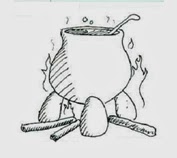
The third addition to the above fact, the word 'dalian' was also found in the term Dalian Na Tolu in Mandailing community as a social system. In this case, the meaning of 'dalian' is the 'cornerstone' or 'resting place'. So 'Dalian Na tolu' means 'pedestal three ' or ' three poundation', ie 'mora', 'kahanggi' and 'anak boru'. Mandailing people embracing patrilineal (patrilineal), the ‘foundation' for future offspring is a boy ('si lian' or 'si dali'). So if the nuclear family had no sons to meneruskaan descent, the nuclear family will break the offspring, which in Mandailing called 'punu' . [EN]


Kamis, 16 Januari 2014

Olong ('afection')


'OLONG': 'COMERSTONE' OF MANDAILING 
SOCIAL SYSTEM ('DALIAN NA TOLU')

by Edi Nasution


In general, each community has followed orders and obeyed by its citizens to prosper. Order was based on the philosophy of life which is the noble values ​​of the society itself. Likewise with Mandailing community has high values ​​(cultural values) ​ which is based on the values ​​that have been engraved in the hearts of each anggotaanya called 'olong', which arises from the depths of the deep and the deep thinking anyway.

If 'olong' has been integrated, there arises a society that 'marsiolongan'. Furthermore, if people have 'marsiolongan' , then the resulting also the people who feel they have a sense of unity. Sense of unity that is the embodiment of 'olong' was called 'domu'. Therefore, 'olong dohot domu' can not be separated from one another, because 'olong mangalap olong' cause 'domu'. To be 'domu' be maintained, then every member of society must be imbued with the sense of 'olong'.

Interaction 'olong' causing 'domu' will bring 'parsaulian'. Thus the realization of 'olong maroban domu' , and 'domu maroban persaulian'. In this case, 'olong dohot domu' that is the basic philosophy ('filosofie grondslag') from Mandailing community, which is the source of all sources in the public order act. To implement the 'olong dohot domu' for real (concrete) in Mandailing citizens in public life or in organizing various ceremonies, both 'joy' ('siriaon') and that is 'sorrow' ('sidangolon' or 'Siluluton'), required an institution called 'Dalian Na Tolu' (H. Pandapotan Nasution , 2013:1).

Mandailing the kinship system is 'patrilineal', and kinship relationships can be reviewed by consanguinity ('blood ties') and marriage ('marital ties') are patterned. In this case, the Mandailing peopele themselves into three groups of kinship is the 'pedestal base' ('dalian') for various socio-cultural activities.

According to lore, the three kinship groups each resident as a 'mora', ie 'giver girls', 'anak boru', is the 'recipient of girls', and 'kahanggi' is a group of relatives of the 'clan' , which bound the three together another is based on functional relationships in a social system called 'Dalian Na Tolu' ('pedestal that three'). By using a social system 'Dalian Na Tolu' that is the Mandailing people organize and implement various socio-cultural activities, as well as forming a legal partnership('adattrechts gemeenschap') whose real name is 'Janjian' (Pangaduan Z. Lubis , 1986: 75 ) .

In addition to the above three groups of kinship, the Mandailing also recognize the other as a kinship group which actually comes from the additional three core kinship groups, such as the 'mora ni mora' and 'pisang raut'. 'Mora ni mora' is the 'mora' rather than 'mora', and 'pisang raut' (sometimes also called a 'kijang jorat' ) is 'anakboru' rather than 'anak boru'. Moreover, some kinship groups called 'kahanggi pareban', namely the kin group consisting of several different 'marga' of nuclear family, but equally a 'anak boru' of a family of specific clan.

Based consanguinity are kinship group called 'saompu parsadaan' ('the grandfather shared'), 'saompu' ('the grandfather'), 'sabagas' ('one home') , 'saudon' ('one pot') and 'saama-saina' ('one father and mother'). Kinship group called 'saompu' is a collection of people a clan who was a grandson of the few people whose grandparents siblings (brother and sister ) ; 'sabagas' is a collection of some of the children as siblings genera; 'saudon' is a collection of the clan as the grandson of an old man, and 'saama-saina' is a collection of some of the children from the father and mother pairs, in which does not include 'stepchild' and  'foster child' (Zulkifli B. Lubis, 1988:31-32 ).

According Zainuddin Pangaduan Lubis, 'olong' ('affection') is Mandailing cultural values ​​are the highest and most abstract is the basis for a functional relationship between the three kinship group, who was born as consanguinity and relationship marriage as essence of kinship that all three groups. Philosopically, Mandailing people each integrated into kinship group 'mora', 'kahanggi', and 'anak boru' which bound the functional relationship always put themselves as people who 'sahancit sahasonangan' and 'sasiluluton sasiriaon' (pain and felt happy with). As a consequence of such a philosophical is that the Mandailing people  be 'sahata saoloan satumtum sapartahian' (fused in a unanimous consensus to agree) and 'mate mangolu sapartahian' (life and death in a consensus to agree).

Furthermore Zainuddin Pangaduan Lubis explained that in line with the creation of an ideal social system in the form of "large network", then the Mandailing and philosophically - symbolic to be pattern himself as a 'jala' ('mesh') equilateral triangular. Every corner is a vital position in the rights and obligations of each kinship group. Because of peak placed at an angle of descent groups 'mora', and the two other angles are also placed kinship groups 'kahanggi' and 'anak boru'. Position three can be switched at any time due to the practice of marriage, marriage is precisely what creates and relationship sides stretched linking all three to form the basic pattern of socio-cultural life of the Mandailing a large triangle. It is functionally integrated in a large number of triangle-triangle group into small kinship follow a basic pattern that becomes a reference. As a totality, the big triangle with a triangle - small triangle which becomes transformed into a system of 'Dalian Na Tolu' contents. As is the case with a 'net', the entire rigging network united by a rope from a binding handle peak. According to the philosophy of the Mandailing people, 'cord grip' that 'olong' that unites each group kinship and community members Mandailing in a social system 'Dalian Na Tolu' that is.

In addition to the kinship group that has been stated above, those other types of grouping, which is what is commonly called 'koum-sisolkot'. The term 'koum-sisolkot' is formed from two words, namely 'koum' and 'sisolkot', each of which has meaning in the context classificatoris kinship system. According to Zulkifli B. Lubis (1988), 'koum' is a term that referred kinship based marital relationship, while 'sisolkot' referenced by blood ties. Therefore, people who are a clan (called 'markahanggi') is also commonly referred to as 'marsisolkot'. While the definition of 'koum' include more members and a wider scope in that it is integrated kinship groups 'mora', 'kahanggi' and 'anak boru', a close neighbor and so forth. Having regard to the term 'koum-sisolkot' that preceded the word 'koum' and not vice versa, perhaps this is not happening by chance and without any particular meaning contained therein. If it is assumed that "language to determine the pattern of culture", it is possible that the term 'koum-sisolkot' is reflection of 'cultural patterns' or at least there are cultural values ​​rooted in customs Mandailing people, so it can be assumed that "Mandailing people in many ways no more priority 'sisolkot' in his life, but rather in favor of 'koum' socially-psychological and territorial closer to him".

In everyday life people often utter a word Mandailing yangsangat closely related to various aspects of their lives, the 'dalian'. The word 'dalian' as a concept (elementary and fundamental formulation) refers to a group of symptoms or facts that exist in society Mandailing, which can be observed both directly and abstract (Edi Nasution, 2013).

In Mandailing a boy called by name as 'lian' or 'dali', is short for the word 'dalian'. When parents send their sons to do various things, for example, to draw water from the their wells, the father or mother will say: "Lian, buat jolo aek sian sumburta i !" ("Son, first take water from our wells it!"). Nickname 'lian' is actually not only used by his parents to call their own son. Man others are older than the boy can call or address him by the name of 'lian'. Although a man old enough age, he can still be called by the name of 'lian' by people whose age was older than him. But on the contrary, a man will not call another man whose age is much older than him as 'lian' because it was not worth doing.

In daily life there are times when a person expresses his frustration to a friend or his brother, saying: "na bahatan si dalianmu, uboto dei!" ("a lot of reasons, it's him I !"). The emergence of a sense of frustration that his friends or relatives,  for example because it does not go well granted his request by always looking for reasons or excuses that do not make sense. For example, someone wants to borrow some money to a friend, many times he repeated his request when they met, but it does not give her a variety of reasons that are likely making it up, so it makes it irritated and angry , and go out, 'swear' it .

As a human being by nature live in pairs that are born with different sex, the opposite sex 'si lian' is a girl called 'si taing', is abbreviation of the word 'tataring'. Mandailing people in the house called 'bagas' or 'aratak', generally 'tataring' placed in the kitchen of the house at the rear portion. Construction 'tataring' rectangular made ​​of boards as walls and floors, in which evenly filled with soil and a jib padat.Sedangkan poles are made ​​of wood, and placed firewood on the bottom. Above the ground is flat and solid itudiletakkan three stone with triangular position called 'dalian', and on top 'dalian' that's the housewife (also called 'induk ni tataring') put the 'udon tano' ('pot') for cooking rice.

The third addition to the above fact, the word 'dalian' also found in terms of 'Dalian Na Tolu' as a social system Mandailing people. In this case, the meaning of 'dalian' is a 'pedestal' or 'resting place'. So 'Dalian Na Nolu' means 'pedestal that three' or 'three support', ie 'mora', 'kahanggi' and 'anak boru'. Mandailing people embracing patrilineal, then the 'pedestal' for the continuation of offspring is a boy ('si lian' or 'si dali' as a 'beacon of hope') in their lives. So if the nuclear family had no sons to carry on their offspring, the 'nuclear family' will break the offspring, which in Mandailing language called 'punu'.

Jakarta , January 2014 .
Edi Nasution


REFERENSI
Z. Pangaduan Lubis, “Namora Natoras: Kepemimpinan Tradisional Mandailing”, Skripsi Fisipol USU Medan, 1986.
________, Kisah Marga-Marga di Mandailing, Medan: Yapebuma, 1986.
H. Pandapotan Nasution, “Dalian Na Tolu”, makalah disampaikan pada Sarasehan Kebudayaan Mandailing, Gedung Dewan Pers. Jakarta, 1 Juni 2013.
Basyral Hamidy Harahap, “Aksara Mandailing: Tinjauan Sosial Budaya”, makalah disampaikan pada Sarasehan Kebudayaan Mandailing, Gedung Dewan Pers. Jakarta, 1 Juni 2013.
Zulkifli B. Lubis, “Manipol: Studi tentang Orientasi Nilai Budaya Mandailing”, Skripsi Medan: FISIP USU, 1988).
Edi Nasution, Tulila: Muzik Bujukan Mandailing, Penang-Malaysia: Areca Books, 2007.
________, “Dalian Na Tolu”, http://gondang.blogspot.com/2010/08/dalian-na-tolu.html, diakses 2-10-13.

Entri Populer

Total Tayangan Halaman