Tampilkan postingan dengan label markusip. Tampilkan semua postingan

Sabtu, 04 Oktober 2014

"dongung-dongung"


Between 'Pior' and Love 


Introduction

LIFE IN Mandailaing past society has been characterized by a cultural value system that does not allow for interaction open (free) between boys and girls, so that however the flame burning love between them must be done (combined) in secret. 

In such circumstances, the language leaves (bladerentaal) is an alternative means of communication to express heart's content. For example, a young man wants to say "do not get any separation between us" to her lover, the young man will send the leaves of plants: simardulang-dulang ('ulang' = do not), leaves sitata ('ita' = us), and leaves sitarak ('marsarak' = split). For more details see the paper by Drs. Z. Pangaduan Lubis titled "Mandailing dan Kita: Suatu Perkenalan Awal" (1990) as "Discussion Mandailaing Culture" at the Faculty of Letters USU Medan. 

Although the "language leaves" (bladerentaal) has been popular in the past, but it is also possible existence of obstacles for a young man or a boy and a girl who wants to express to each other's heart. As the difficulty met to deliver leaves, feelings of mutual unwilling  or fear when "gayung tidak bersambut​​" (rejected). Given these barriers, it does not mean the young man desperate to be able to captivate the girls wanted. Apparently, there are many ways that can be taken, where one of them is to use a musical instrument called 'pior'. 


Organological and Classification 

Pior is a sound instrument made ​​of bamboo, wood, areca sheath, and parts of the cane as a binder. Of a round piece of wood and lightweight (timber named atinar or goti) formed into sheets of wood whose length is approximately 80 cm and width 10 cm, made ​​a hole in its center axis. 

Then the sheet was formed into a wooden windmill 'double plate', and the two ends fastened to a pair of powerful sound tool called 'dongung-dongung'. Dongung-dongung is made from a piece of bamboo named 'bulu Poring', whose length is about 15 cm from the 'book' is intact up to the cut edges taper, and about 3-4 cm in diameter bamboo. 

In the hole axis are given a sort of "pen" made ​​of small bamboo, while the wick is made of bamboo round. And the extension axis (in the back) is equipped with a wind direction regulating stem of betel nut tree ('Laklak'). Laklak is useful for finding the direction the wind is blowing, which in turn pior device is placed on the vertical bamboo tubes and has a "buku" or "ruas" on near the transverse axis. Furthermore, through the vertical hole bamboo tube is inserted milestone logs as pior poles. Pior pole length is adjusted to the needs, then planted on the ground. 

After pior perfectly fixed, then appabila prontal wind blowing against pior, pior so it will rotate vertically along dongung-dongung each attached at both ends. As a result of turning dongung-dongung, then there was a clash "column of air" on the tube dongung-dongung. Furthermore, this clash of the air column produces the "vibe", and with a certain frequency of this geteran will produce noise or buzzing sound. 

We know that sounds pior stronger at night because it is in line with the principles of physics, where at night the air is more dense on the surface of the soil, and consequently the sound produced pior curved downward, while in the afternoon the opposite. 

In connection with that has described above and also in accordance with the instrument's classification method proposed by Curt Sachs and Hornbostel (1881-1969), the 'pior' is equipped with 'dongung-dongung' This includes the classification of musical instruments 'aerofon'. 


Use and Function 

Pior is generally installed in hilly areas, or can also be tied to the lowland kuini or mango tree, in order to get more wind. As has been put forward at the top, where pior is equipped with two musical instruments (dongung-dongung), which is made from a piece of bamboo cut taper, tied at both ends. Making this clear dongung-dongung actions deliberately designed by a young man for a particular purpose. In this case to captivate a girl who coveted the creator pior

According to information from some parents, dongung-dongung previously smoked with incense, as an introduction to the incantations that will be spoken by the creator pior. With the expectation that the 'noise' generated 'dongung-dongung' (called 'pitunang') can deliver the desired desire pior makers (youth) to a girl who wanted. Usually after pior fixed within a few days, it could be her intended child began to wonder to myself, daydreaming, and overcome by longing. 

In these circumstances the usual · girls began to show a reaction to finding someone dear to his heart, but he does not know who on earth. He started acting actively associate and occasional visiting relatives outside the village. In a situation like this can likely meet with the young man pior makers. After meeting with the boy, the girl felt something 'thing' that touches the deepest feelings, and he felt drawn to the personality of the youth. 

In an atmosphere like this encounter, 'perhaps' the young man was not only rely on the power of 'pitunang' alone, but he might as well wear a 'glamor' extras, such as fragrant-Haruman or prayers (mantra) certain designated for the girl child, to be more impressive about the young man to receive love pior makers. So the relationship between them can be established familiar, and the girl felt safe, peaceful, and protected on the side of the youth, and the most likely "gayung" (tit) was intercepted. 

Departing from the above description, and although the author has not had time to document the sound of 'dongung-dongung' (a monotone voice), and 'mantras' are spoken by the creator pior, the authors argue that the behavior is not a practice pior makers 'magic'. Therefore, the creator and master pior not use force and occult laws that exist in nature to achieve its objectives. But it is a form of 'religious', this is in accordance with the concept proposed by JD Frazer in his book The Golden Bough (1890), that "religion is a system of all human actions to achieve a purpose by way of thrusting themselves to the area and power of spirits such as spirits or gods, and others who occupy nature". 

In the period before the introduction of Islam to Mandailing, the people there embraced the religious system called "Sipelebegu". It turns out that the religious system (Sipelebegu) is gradually lost since the strong influence of the Islamic religion that more and more embraced and beloved by Mandailaing people, and in turn change the mindset of the people about the 'Godhead'. Nonetheless, Sipelebegu religious system (culture) is still remaining despite been colored by Islam. Accordingly, the presence in Mandailaing pior, as fixed as in Tor Sijanggut - Huta Pungkut (Mandailing Julu)now is probably the remnants of the religious system 'Sipelebegu' is colored by Islamic religion. 


Closing 

As described above, where 'pitunang' can be used to lure and subdue the heart of a girl. Therefore, 'pitunang' is an allure of using 'sound' ("dongug-dongung") as a medium for certain purposes. 

In fact "pitunang" is not only used for the purpose as above, that there are times when mounted on a means of transportation, such as 'cart'. Pitunang to the cart is mounted on 'markusip' (two metal plates as a means of sounds such as "bell"), located at the edge of the wheel axis: left and right, or mounted on a 'gonto' (bells) are usually hooked in the neck buffalo or oxen pull carts. 

There is also hanging in the cart. The use of 'pitunang' on the parts that produce this sound is to captivate the subscription so that they lay their goods to the owner of the wagon pitunang put in his cart. 

In Mandailaing, we know about the youth event "markusip" (tradition dating by way of whispering between young men and women were confined walls of the house at night, see Edi Nasution, Muzik Bujukan Mandailing, 2007), and it turns out this markusip tradition did not escape the use of a variety of musical instruments that use 'pitunang' like 'tulila', 'sordam', or 'genggong' (jaw's harp). 

Furthermore, it can be assumed (by the author Edi Nasution and Ir. Hafis Nasution) that the tradition of 'pior' appears earlier than tradition 'markusip' when viewed from the aspect of socio-cultural and technological, in which the system of cultural values ​​in the tradition of 'pior' very strict and tools musical 'pior' itself produces only one sound or a humming sound (drones) continuous (monotone), and the perpetrator is still a secret. 

While the cultural value system of the future has begun to loose markusip tradition, and have been wearing various brass instruments are more melodic (has some holes tones), as well as the offender has begun to show courage. 

Finally, since the development of technology to reach the villages as a means of "listrik masuk desa" (lighting rural electrification), and the era of information (tv, radio, newspapers, etc.) that greatly affect the "mindset" Mandailaing society, so that both traditions 'pior' and 'markusip' in relation to the lost romance began with the times.*** 


Published in Harian Waspada Medan, 1990.


~o0o~

Kamis, 14 Agustus 2014

Tulila & Markusip

Reviews for "Tulila: Musik Bujukan Mandailing"


Tulila: Muzik Bujukan Mandailing. Edi Nasution. Penang, Malaysia: Areca Books, 2007. xx + 180 pp., photographs, maps, figures, musical ex., bibliography, index. ISBN: 978-983-42834-4-5, RM35.00.


Tulila: Muzik Bujukan Mandailing (Tulila: Mandailing seduction music) is Edi Nasution’s Indonesian-language study of markusip, a disappearing, late-night, rural courtship tradition among West Sumatra’s Mandailing. In markusip, a love-struck pemuda (young man) braves nocturnal risks of the jungle to sneak up to a young woman’s dormitory (bagas podoman), where he leans his shoulder against its thin outer wall, and tries to rouse an anak gadis (young woman) from sleep with faint melodies played on a slender, fourhole, bamboo, reed instrument called tulila, sung quatrains of ende-ende, and prods from a palm-leaf stem through a small hole in the wall called a lubang markusip. His hope is that the anak gadis will awaken and engage him in whispered conversation, the very meaning of markusip.

Readers of Indonesian will welcome this contribution by an indigenous author to the small but growing body of ethnomusicological literature on Southeast Asia’s lesser-known musical practices. Tulila’s scope is broader than its title suggests. Its five chapters unite tulila performance with various facets of aposoan (the idealized life of Mandailing youths in their premarriage years), broader markusip courtship traditions, and post-courtship engagement rituals (patobang hata). Nasution is a Mandailing ethnomusicologist, native to the region, and an insider to the society he describes, though we do not learn much about his personal connection to markusip or the communities in which this study is based. Mandailing lands are comprised of two regions, and their political subdivisions, called huta, are linked by the northward-flowing Batang Gadis River. They have traditionally been dominated by two principal marga “clans”: the Lubis marga of the mountainous, upper Mandailing Julu to the south, and the Nasution marga of the swampy lowlands and foothills of lower Mandailing Godang to the north. Nasution’s fieldwork took place in the former, his native Julu, as it was the only area where he encountered extant tulila activity. His methodologies include interviewing numbers of Mandailing (including tulila players, community leaders, cultural guardians, and young people), learning how to construct and play tulila, Reviews 133 transcribing and analyzing his field recordings, and writing ethnographic descriptions that are rich and replete with local terms and concepts, and which comprise a significant portion of this book.
Chapter 2 introduces Mandailing history, territory and culture, touching upon its origin myths, premodern alphabet and texts, surviving antiquities, legends, traditional rulers, and clan system, as well as its performance genres, instruments, ensembles, songs, and dances: much of what constitutes a Mandailing identity.
A central undertaking of this book, advanced in this chapter and later in chapter 5, is to correlate tulila to dalian na tolu, a canon of Mandailing concepts and practices governing kinship relations, gender roles, and social stratification—glossed in Indonesian as tumpuan yang tiga, or “three pillars.” According to Nasution, the “pillars” symbolize roles performed

by three clan-based groups who interact in a traditional wedding engagement, and meanings they embody. He uses a triangular paradigm to illustrate their relationships; clockwise from the vertex are the mora who “give away” the young woman, the anak boru who “receive” her, and the kahanggi who deal with the arrangements.

Chapter 3 covers a diverse range of topics, and contains an abundance of ethnographic information, though its organization is not particularly coherent. It begins with a rich description of a markusip outing and texts showing how pemuda and anak gadis interact through ende-ende. This is followed by a hodgepodge of explorations of tulila: what it expresses and communicates, how it entertains, its relationships to Mandailing language, poetry, traditions, symbols, and beliefs, and comparisons between markusip in different historical eras. In a section on tulila and si pelebegu, Nasution shows how a pre-Islamic belief system that still guides Muslim Mandailing society informs tulila construction and playing techniques.
Through si pelebegu, the pemuda imbues his instrument with love magic in order to stir sadness in the anak gadis when she hears it played, and capture her heart. We learn that this enchanting quality is obtained by harvesting the bamboo when “sorrowful” sounds fill the air—such as the shrieks of a soaring eagle or the mournful cries of a grieving family—or by placing the bamboo in a coffin alongside a corpse as it awaits burial. Discussions of ende-ende poetry, here and elsewhere in the book, do not convey to the reader how it sounds. And they might have benefited from comparisons to other genres in the region, whether in regard to the use of parable, floral symbols, and nonlexical syllables to heighten expressive delivery (which calls to mind the Malaysian dondang sayang, the Deli-style senandung, and southwest Thailand’s phleng tanyong), or contrasts in rhyme schemes between hata andung (a literary idiom) and hata somal (a common vernacular) forms. A discussion of customary norms, baso and sangko (67– 68), helpfully illuminates the importance Mandailing attach to 134 Asian Music: Winter/Spring 2014 guarding the clandestine nature of markusip (so as not to challenge moral standards), but might have fit more appropriately in chapter 2.
Chapter 4 deals with tulila construction, learning methods, and playing techniques. It explains how a thin, wild variety of bamboo, bulu sorik, is selected, cured, and fashioned into a four-hole instrument, with accompanying illustrations of carving methods and tulila in various sizes and builds. Tulila is learned through imitation and repetition, and its pedagogy is discussed in terms of its all-male mentorship system that comprises several age groups: (1) elders who possess broad knowledge of Mandailing traditions; (2) older “young at heart” men who pay evening visits to the boys’ dormitory to bring them amusing stories and life lessons; and (3) the boys’ older peers who have already gone on markusip outings, or who have a particular talent for the courtship arts. Two musical transcriptions provided here (92) represent sung syllables used to convey a tulila melody from teacher to student, for the latter to memorize. As boys learn, they are free to develop an individual style through melodic variation and ornamentation, though readers are not given an idea of how these might sound.

Chapter 5 contains transcriptions and analyses of tulila melodies based on recordings of two elder Julu performers, rendered in common Western staff notation, and five-line fingering tablature. Nasution’s first concerns are with melodic contours of brief phrases, and their arrangement in sequences. He then shows how each discrete formal section has a corresponding identification to both a “pillar” of dalian na tolu, and one of the five pitches (including the highest, unstopped note). To compensate for the disparity between three pillars and five pitches/sections, he includes the patobang hata engagement ritual alongside dalian na tolu, matching it to the “opening” pitch (the first-hole pangindik) and introductory melody. In addition, he refers to a Mandailing saying, opat ganjil lima gonop (four odd/five even, or four incomplete/five perfect), to explain the enigmatic fifth pitch, whose absence would leave an pemuda and anak gadis feeling uncomfortable, as if something were missing—just as a ceremonial betel nut platter at a patobang hata ritual would be perceived as incomplete without its five requisite ingredients: Piper betel, areca nut, lime, gambier, and tobacco.
While Tulila is a commendable effort, it has a number of deficiencies that should be noted. Its perspective is largely male, with very little attention given to the anak gadis. The ethnographic writing paints a somewhat general and ahistorical portrait of Mandailing. Its organization and focus can seem confounding. A whole section of melodic transcriptions (109– 13) is marred by a sloppy manuscript that makes it difficult to distinguish some pitches on the staff. An especially frustrating omission is the lack of a glossary of Reviews 135 Mandailing terms, which appear so abundantly in the text. Most surprisingly perhaps, there is no mention of neighboring ethnic groups who share similar social practices, such as the Batak or Minangkabau, or any effort to contextualize tulila within the greater region. However, solely for its insights into markusip ractices and Mandailing society, this book is a worthwhile addition to the growing ethnomusicological literature of the region.


Original article by Lawrence Ross, The Graduate Center, City University of New York Featured in Asian Music, Volume 45, Number 1, Winter/Spring 2014, pp. 132-135 (Article)

Minggu, 22 Juni 2014

Young courting in Mandailing


“Flutings of Love”

One newspaper reviews  Tulila: Muzik Bujukan Mandailing, Edi Nasution’s important account of his experience with an increasingly rare source of music.
by Himanshu Bhatt
IMG_4014
Tulila: Muzik Bujukan Mandailing

Edi playing the tulila
IT may seem to be just a simple little instrument made out of plain bamboo, but it produces the sweetest of sounds when played.
The thin tulila flute has produced some of the most passionate and romantic music to come out of the remote region of Mandailing on the western coast of Sumatra.
Today, the knowledge of making the flute and the technique of playing it have become endangered, as only a handful of communities still know how to do these things.
A fascination for the flute gripped ethno-musicologist Edi Nasution, a Mandailing himself, to research the origins and special features of the music the little strip of wood could produce.
Edi’s research, which he started in preparation for his student thesis at the Universitas Sumatera Utara in 1995, is now published in a book called Tulila: Muzik Bujukan Mandailing.
What makes the research precious is that the tradition of making and playing the tulila is expected to become extinct by 2010.
In this era of globalisation, a large portion of our traditional culture is on the brink of disappearing,” says Edi.

The tulila music repertoire is inspired by the sounds of nature
The awareness consumed Edi to travel around 18 districts in Mandailing to document and chronicle the unwritten legacy of this folk instrument.
Edi found that the tulila tradition developed a rather complex repertoire of music that was largely inspired by sounds of nature, as its music emulates the buzz of insects, the chirping of birds and the rustle of the wind.
What makes the bamboo flute particularly distinctive is that it was, until a few decades back, commonly used by men to court women,” Edi explains.
It was common for men to play the flute while reciting improvised pantun (rhymes) in the vernacular language.
Played over hundreds of years, the hand-made tulila flute is a cultural unique feature as it evolved to fuse the art of music among common people.
There are today about 40,000 Mandailings, descendents of migrants since the 19th century, still living in Malaysia,” says Abdur-Razzaq Lubis, the Malaysia-Singapore representative of the Mandailing All Clans Assembly.
Many cultural traits, including the Mandailing dialect, have dwindled tremendously in Malaysia over the past few decades, he adds.
“The research done by Edi is significant to us in Malaysia as there is still some Mandailing music, like the gordang sambilan, being practised here.”
Edi’s efforts triggered an Asian university to express interest in recording the existing repertoire of the tulila tradition before it disappears.
The story of the tulila and its impending demise as an art form and a cultural practice is a reminder to all Malaysians of how fragile and precious the cultural treasures we still have are.
Tulila: Muzik Bujukan Mandailing is available at major bookstores.
Review previously published in New Straits Times, February 3, 2008
~0~
source: http://arecabooks.com/fluting-of-love-by-himanshu-bhatt/

Senin, 03 Maret 2014

Elope

'Mangalojongkon Boru': a tradition 
of elopement in Mandailing


Already a human nature, that they were made ​​by the Creator (God) with two different sexes, namely 'si lian' (‘men’) and 'si taing' (‘women’). When they are small often play together in the fields and garden, on the edge of the river and the forest, or even in their own hometown. But as an adult ('Aqeel-baliq') they no longer get along intimate childhood as constrained by social norms (customary).  If in Mandailing, according to the old tradition, a young man sleeping with peers in a 'sopo podoman' which they made themselves on the edge of the village where they lived, while a girl also sleeping with peers (women) in 'bagas podoman' that usually belonging to an elderly widow (called 'mabalu') because her husband had died.
As a young man who has a raging desire to always be making love - affection (love) with the opposite sex with a love affair in secret, a young man will usually conduct 'mangkusip' on 'bagas podoman' a girl who craves at the time midnight. With the help of a wind instrument called 'tulila', he hopes to be wake her idol's heart so that they can whisper dialogue (called 'markusip') on the still night. Not infrequently, even though she had been awakened from his sleep being disturbed 'tulila' which sounds a bit like the sound of the ‘mosquito’, but he remained silent while enjoying the melodic 'tulila' melodious-woo. 
Not long afterwards, perhaps because his heart was touched by sound 'tulila' or may also be due to feelings of sympathy and compassion (‘pity’), then the girls usually give a response (called 'mangalus' ) of the 'bagas podoman' by way of whispering to inquire purpose and the purpose of the youth 'mangkusip'. When in fact the girl had already knew that the young man wanted in a relationship with him. If the girls want to accept the young man as her lover, then a date in the evening activities ('markusip') that continued once or twice a week until finally they both agree to live together (being husband and wife). To that end, usually the girl request the young man that - quiverful immediately came to apply to her parent and extended family. May be, the proposal not be accepted (rejected) with a wide variety of reasons by parents and extended family girl. Nevertheless, there is still a recourse for both of them to realize their desire to be husband and wife, namely ‘kawin lari’ ('elope') which in the language of (indigenous) Mandailing called 'marlojong' or 'mangalojongkon boru'.
In the tradition (custom) 'marlojong' is usually the only girl carrying supplies (clothes) as only needed and that his departure was accompanied by one or two people (girls) best friends (called 'pandongani'). But before going together to the young man's parents house, usually the girl who will 'marlojong' it will left a message (letter) in 'bagas podoman' to let him go where and with whom. When they got home the boy 's parents, too soon the young man's parents - quiverful gather nearby to deliberate on issues of their boys who had brought a girl into their home to be his future wife. The results of the deliberations that usually they agreed to send a special envoy to the house of the girl's parents to convey the 'Hata Bou: Mandokon Ulang Agoan' (‘message from the boy 's mother that the girl's parents and family no longer need to feel lost or looking for girl have been safely in the young man's parents house’). 
After the girl 's were in the parents house of the youth and cultural activities ‘MandokonUlang Agoan (Hata Bou) was already done in the girl's parent's house, then in the young man's parents usually also held a special activity for the young people called ‘marburangir’ or ‘paboru- boruon’ at night after evening prayers (shalat Isya). In the event these young people, the girl as ‘bride’ (called ‘paboru-boruon’) introduced to the local youth, while her future husband it should not be there. This activity is called ‘marburangir’ for in the event youth is provided ‘burangir’ (‘betel leaf’) and completeness (ie ‘sontang’, ‘soda’, and ‘pining’) as ‘custom food’ (in ‘marburangir’ customary among young people) among them while chatting on a beautiful evening and and it's a fun activity for all young people. 
To create a festive atmosphere and full familiarity among them at night, not infrequently one or two of the local youth asked the girl (bride) to make ‘burangir’ (called ‘maniktiktik burangir’) specifically for him, or to any other girl he liked, who was also present there, even more so to the ‘pandangoni’ of the bride, who is also beautiful when young men would often be asked, even those scrambling to make a request ‘manitik burangir’ as a way to be able to meet in person and at the same also to tease him. In the course of young indigenous ‘marburangir’ this, the young people are often using ‘ende-ende’ (also called ‘pantun’) and ‘uling-kulingan anca’ (‘guessing game’) to reveal their hearts and feelings when interacting (communicating) the each other. ‘Marbungir’ or ‘paboru-boruon’ activity usually lasts for three consecutive nights until late at night, can even last for seven nights in a row for ‘nobility’ (called ‘na mora-mora’ or ‘raja-raja’) in Mandailing. After completing the activities 'marburangir' this, then held traditional wedding ceremony (called 'markaroan' or 'marbagas') ranging from morning to evening.
Ideally something like that expected from the end of an event 'mangalojongkon boru'. However, not infrequently it can create 'hostility' protracted among families of both parties. And for those people who likes to describe 'feud between the two families' is a very unusual incident by saying: "Ulang do pasitik sotik mang get marsitampulan !" 
Until now, the tradition of 'marlojong' is still ongoing in Mandailing. But unfortunately, the events 'marlojong' is sometimes addressed by applying criminal law heritage Dutch colonial power, where any act that violates the laws and regulations (‘err’) should still go to jail, for example one is like a case of an elderly woman in Prabumulih-Lampung regency caught stealing 'singkong' ('cassava') to fill the hungry stomach but was sentenced for 2.5 years. According to the Minister of Justice and Human Rights Patrialis Akbar, the Code of Penal ('KUHP') are now less reflects the sense of justice and the soul of Indonesia, because the Criminal Code itself is a legacy of the Dutch colonial power in the past. In this case, "Changing the legacy of the Dutch Criminal Code is an urgent program to be conducted by the Ministry of Justice and Human Rights. Patrialis Akbar also assured to include 'customary law' in the Criminal Code. Because customary law is a reflection of the soul of Indonesia, especially for people who have embraced for generations. It is true, that the supposed rules of law which is adequate for real life in society ('living law') such as customary law 'Mandokon Ulang Agoan' ('Hata Bou') to address issues such as the case of 'mangalojongkon boru', which from one side sometimes still seen as criminal offense. Although the 'tulang' or 'mora' ('uncle') of the girls had a big hand as 'na pagodang-godangna' so he often request 'batang boban' ('dowry') were higher to the family of the young man for those girls were like 'sere saulu ni kudo '('gold for at the head of a horse). His family (boy and families) does not need to worry because 'tola do marutang sapanjang adat' (possible owed ​​by custom), as the saying goes "hata-dupang dupang, hata-hata do panggayar utang". That is, 'the words' can be used as a means of paying the debt. In connection with that, events 'marlojong' ('mangalojongkon boru') in Mandailing more appropriately addressed by performing traditional ceremonies ‘Mandokon Ulang Agoan’ (‘Hata Bou’) is ‘local wisdom’ as a heritage of the Mandailing people.

Gandoang. March, 04, 2014.
Edi Nasution

~o0o~


Minggu, 09 Februari 2014

Mandailing Culture (5)

MANDAILING CULTURE: A BRIEF OVERVIEW


3 . Social Strata

In Mandailing people found the social stratification that has lasted for generations in three layers, namely: (1) 'namora-mora', is of the nobility; (2) 'alak na jaji' or 'si tuan na jaji', is ordinary people or ordinary people, and (3) 'hatoban' or 'partangga bulu', is a slave. However, in some ‘huta’ in Mandailing, between the layers 'na mora- mora' and 'alak na jaji' are intermediate layer called 'na-toras-toras', is a society that does not leaders status and nobility of ordinary people, or may be said notch 'na toras-toras' lower than the nobility, but higher than ordinary people.

'Na mora-mora' is a distinct group within a group of his clan, who are patrilineal derived from the founder 's first 'huta' (called 'pamungka huta'). This suggests that at first the status of nobility first born but was not brought because the high appreciation of the founding members of the public to the first 'huta' they are, only then inherited the throne in sequence to the descendants. Because that is seen as the first founder of a number of 'huta' in Mandailing was surnamed Lubis and Nasution, so that only the two genera that are there layers 'na mora-mora'. While the 'na tora-toras' the relatively few were created from kin groups whose members no marital relations with a close relative or a king 'na mora-mora'. So in general society is a layer Mandailing 'alak na jaji'.

Figure. Mandailing king in the past.

It may be said that the difference between 'na mora-mora' and 'alak na jaji' is not so prominent in everyday life because actually the 'na mora-mora' and 'alak na jaji' is a clan always realize that both parties have a blood relationship. While the 'clans' other classified as 'alak na jaji', usually 'na mora-mora' have kinship ties based on a marital relationship.

The bottom layer is 'hatoban' or 'partangga bulu' can be divided into three categories based on the things that cause them to become part of the layer. First, because they do not pay their debts, secondly, they are the ones who accidentally purchased to serve as slaves, and third, they were enslaved because they were lost and defeat in war. Nobility in Mandailing can be identified easily because they usually hold the title include: 'Raja' , 'Sutan', 'Mangaraja', and 'Baginda'. In addition, their homes decorated with ornaments typical of the so-called 'bagas na martanduk' or 'bagas na marbolang'.


4 . Intercourse Between Indigenous Kinship Group

Socio-cultural interaction in public life Mandailing based on the custom. In a nuclear family, for example, the relationship between parents and their children are still young arguably lasted quite familiar and full of affection. However, a good relationship with a father whose daughter has status as 'bujing-bujing' extremely limited because it is restricted by customary norms. The father always limit themselves to dialogue directly with an adult daughter who has been the vice versa the girls feel embarrassed and ashamed to talk about various things with his father. This situation makes a girl who has grown to feel more close and intimate with his mother. Similarly, a boy who has grown too limiting to do with his mother. That is why their children have grown up not sleeping together with their parents at home, but at home or a particular place. The girls sleep with fellow peers in a house called 'bagas podoman', while the boys sleep with his friends in 'sopo podoman'.


Figure. the king and his big family.

Meanwhile, the social interaction between a young man with a grown-up sister (called 'bujing-bujing') also should not open and close. In the past, 'pantang' (taboo) for a young man to linger in the house when his sister (called 'iboto' ) is also in the house. More broadly, such a thing was true for boys and girls is a clan called ‘mariboto'.

In the kinship system 'Dalian Na Tolu', the social interaction between the 'mora' and 'anak boru' based on the rights and obligations of each against each other. In this case, the parties 'anak boru' to carry out the functions as “sitamba urang siorus na na lobi” (the less the deduction enhancer more). Because of such obligations, the 'anak boru' also known as "na manorjak tu pudi juljul tu jolo" (which hit the back of the stand to the next ), which means the 'anak boru' is already supposed to defend the interests and glory of the 'mora', or in other words the 'anak boru ' must “sangap marmora” (honor and glory to the 'mora'). In addition, 'anak boru' also described as 'si tastas nambur' (repellent morning dew on the bushes), which means the 'anak boru' obligation as a precursor (front row) to resolve the problems faced by the ‘mora’.


Figure. Lance for battle.

All that must be implemented parties 'anak boru' because he was obliged to "manjuljulkon morana" (raise the dignity of the 'mora'). In contrast, the 'mora' obliged to “elek maranak boru” (compassion and love parties ' anak boru' ) so that the parties ' anak boru' always “manjuljulkon morana”.

Against 'kahanggi' (brother which has the same clan), each person usually always try to be careful. For kahanggi very important for every individual because of life issues such as marriage, death, and making a living in advance and discussed with ‘kahanggi’. For this case, the parents always give advice to “manta-manat markahanggi” (be careful of the 'kahanggi') to avoid disputes arising among those ‘sakahanggi’. People are a clan called 'markahanggi' (‘sakahanggi’) is expected to always be able to cooperate in dealing with a wide variety of life challenges, such as the explicit and implicit in the 'ende-ende' (poem) following:

songon Siala Sampagul                      ('like fruit fused Siala')
rap tu incat rap toru                              ('both up and down')
muda malamun saulak lalu             ('when a young cook it all at once')
muda magulang rap margulu        ( 'if rolled margulu equally muddy')


5 . Intercourse Indigenous Youth

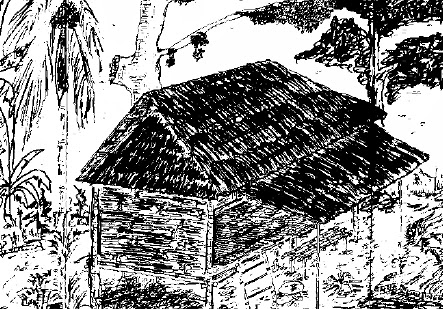
Previously been stated that the youths and girls have a habit of sleeping in groups outside his parents' house. The house specialty beds for girls called ‘bagas podoman', whereas a place to sleep for the youth called 'sopo podoman'. Usually the girls went to their podoman bagasse at around 20:00 pm (evening) and at dawn they returned to their homes to help her housework and also help their parents work in the fields or in the field, and similarly as with the youth. It may be said that almost all the necessities of life for youth and girls are still covered by their parents.


Figure. Sopo Podoman.

It is not considered appropriate when a girl wandering around or just go somewhere alone. Because such behavior can lead to prejudice in society. When a girl is about to leave the house for example to meet with his friend, he was accompanied by a 'inang' (mother), 'etek' (mother 's sister), 'bouk' (father 's sister), or at least not by 'anggi' (sister) his own. When outside the house, the girls would not normally pass through the gathering places men like 'lopo' (coffee shop) or 'sopo podoman'. This is done to maintain her dignity so that citizens do not view it as 'bujing-bujing na urgit ' (flirtatious girl). From the other side , the clothes worn by the girls pretty decently as they closed on the head with 'busaen' or 'songkok' (veil), while the body and feet wrapped with brackets clothes (overalls) and 'abit' (sarong flower patterned).

Instead the movement of young people arguably freer than girls. At certain moments the young man often seen in schools for example, when they 'mardalan-dalan' (streets) in the afternoon, and at night they gather in 'sopo podoman'. In the past, the appearance of youth daily always wear 'kupiah' or 'lobe' (cap) and not to forget also a 'abit kaung' (sarong patterned straight lines), dressing on the shoulder or wrapped around the waist. They are usually dressed 'gunting cino' (Chinese style clothes) and 'saraor panjang' (trousers). In addition, each youth generally have a 'piso balati' (dagger) that much use for them such as to make wind instruments 'tulila' or make a 'lubang pangkusipan' to 'markusip'.

Although the movement of socially 'na poso na uli bulung' constrained by custom are quite strict, but there are some occasions that allow them to interact that can be divided into three forms of activity. First, is a joint activity with other community members as the event ‘marburangir’ ('paboru-boruon') in the house before the groom-traditional wedding ceremony held a few days later. Second, is the activity of young people in filling their leisure times like the show 'mangarabar'. And third, is the interaction of young people in dating activities confidential, ie 'markusip' (‘date’).


Figure. Bagas Podoman.

The presence of Tapanuli cinema around 1960 in Kotanopan and Panyabungan have made a lot of changes in the association of young people in Mandailing. People who watch movies in the theater, both men and women, both young and old, together to watch a movie that was imported from abroad, but the seating is segregated between men and women, where women are placed on the back , and the man on the front. The films they love generally comes from the India (Hindustani Film) with songs lilting seduction and romance stories -blue. In addition, especially the men generally also like cowboy films of the Americas.

In line with that, came the dramatic arts performances ('theatrical') and music (called 'marband'), which is often also interspersed with ‘marlawak–lawak’ (jokes, comedy) at the time of Eid (called 'Ari Rayo'), Independence Day (August 17), and the National Education Day (May 2) at ‘Pasar Kotanopan’ and ‘Pasar Panyabungan’ the event name ‘Pesta Taman' (Garden Party). The intensity of such entertainment is more incentive to take place from year to year, which makes pargaulan youth in Mandailing more liquid and open, so that the old traditions such as 'markusip', 'marburangir', and 'mangarabar' they have left because it was considered obsolete (ancient).

Since the 1980s, the young people have been accustomed to doing Mandailing 'marmayam', 'marlancung', or 'raun' (picnic) to places of special relationships among them, such as 'Paronasan' in the Maga - Kotanopan and 'Sipaga-paga' in Aek Godang- Panyabungan. There, they are available all day while 'dating' . At this time , young men and women have often looked Mandailing hand in hand together in public transport and roads, all the more so when the 'ari poken’ (day of the week) in Kotanopan (Saturday) and Panyabungan (Thursday). Even sometimes the youth ( 'poso-poso') came for ‘mangepek’ {‘tease’) the girls, and they also seem familiar eating ie ‘pocal’, noodles, cakes moist collectively jokes together while having a good time at the point of sale (called 'parjagalan') like 'snacks' in the week it was quite crowded. Such a situation continued until now. However, it should be noted that even though they're quite intense interaction and open , young men and women in Mandailing while maintaining the boundaries of decency and morality in accordance with the customs and norms of their religion. [EN]


Entri Populer

Total Tayangan Halaman