Tampilkan postingan dengan label sopo podoman. Tampilkan semua postingan

Senin, 03 Maret 2014

Elope

'Mangalojongkon Boru': a tradition 
of elopement in Mandailing


Already a human nature, that they were made ​​by the Creator (God) with two different sexes, namely 'si lian' (‘men’) and 'si taing' (‘women’). When they are small often play together in the fields and garden, on the edge of the river and the forest, or even in their own hometown. But as an adult ('Aqeel-baliq') they no longer get along intimate childhood as constrained by social norms (customary).  If in Mandailing, according to the old tradition, a young man sleeping with peers in a 'sopo podoman' which they made themselves on the edge of the village where they lived, while a girl also sleeping with peers (women) in 'bagas podoman' that usually belonging to an elderly widow (called 'mabalu') because her husband had died.
As a young man who has a raging desire to always be making love - affection (love) with the opposite sex with a love affair in secret, a young man will usually conduct 'mangkusip' on 'bagas podoman' a girl who craves at the time midnight. With the help of a wind instrument called 'tulila', he hopes to be wake her idol's heart so that they can whisper dialogue (called 'markusip') on the still night. Not infrequently, even though she had been awakened from his sleep being disturbed 'tulila' which sounds a bit like the sound of the ‘mosquito’, but he remained silent while enjoying the melodic 'tulila' melodious-woo. 
Not long afterwards, perhaps because his heart was touched by sound 'tulila' or may also be due to feelings of sympathy and compassion (‘pity’), then the girls usually give a response (called 'mangalus' ) of the 'bagas podoman' by way of whispering to inquire purpose and the purpose of the youth 'mangkusip'. When in fact the girl had already knew that the young man wanted in a relationship with him. If the girls want to accept the young man as her lover, then a date in the evening activities ('markusip') that continued once or twice a week until finally they both agree to live together (being husband and wife). To that end, usually the girl request the young man that - quiverful immediately came to apply to her parent and extended family. May be, the proposal not be accepted (rejected) with a wide variety of reasons by parents and extended family girl. Nevertheless, there is still a recourse for both of them to realize their desire to be husband and wife, namely ‘kawin lari’ ('elope') which in the language of (indigenous) Mandailing called 'marlojong' or 'mangalojongkon boru'.
In the tradition (custom) 'marlojong' is usually the only girl carrying supplies (clothes) as only needed and that his departure was accompanied by one or two people (girls) best friends (called 'pandongani'). But before going together to the young man's parents house, usually the girl who will 'marlojong' it will left a message (letter) in 'bagas podoman' to let him go where and with whom. When they got home the boy 's parents, too soon the young man's parents - quiverful gather nearby to deliberate on issues of their boys who had brought a girl into their home to be his future wife. The results of the deliberations that usually they agreed to send a special envoy to the house of the girl's parents to convey the 'Hata Bou: Mandokon Ulang Agoan' (‘message from the boy 's mother that the girl's parents and family no longer need to feel lost or looking for girl have been safely in the young man's parents house’). 
After the girl 's were in the parents house of the youth and cultural activities ‘MandokonUlang Agoan (Hata Bou) was already done in the girl's parent's house, then in the young man's parents usually also held a special activity for the young people called ‘marburangir’ or ‘paboru- boruon’ at night after evening prayers (shalat Isya). In the event these young people, the girl as ‘bride’ (called ‘paboru-boruon’) introduced to the local youth, while her future husband it should not be there. This activity is called ‘marburangir’ for in the event youth is provided ‘burangir’ (‘betel leaf’) and completeness (ie ‘sontang’, ‘soda’, and ‘pining’) as ‘custom food’ (in ‘marburangir’ customary among young people) among them while chatting on a beautiful evening and and it's a fun activity for all young people. 
To create a festive atmosphere and full familiarity among them at night, not infrequently one or two of the local youth asked the girl (bride) to make ‘burangir’ (called ‘maniktiktik burangir’) specifically for him, or to any other girl he liked, who was also present there, even more so to the ‘pandangoni’ of the bride, who is also beautiful when young men would often be asked, even those scrambling to make a request ‘manitik burangir’ as a way to be able to meet in person and at the same also to tease him. In the course of young indigenous ‘marburangir’ this, the young people are often using ‘ende-ende’ (also called ‘pantun’) and ‘uling-kulingan anca’ (‘guessing game’) to reveal their hearts and feelings when interacting (communicating) the each other. ‘Marbungir’ or ‘paboru-boruon’ activity usually lasts for three consecutive nights until late at night, can even last for seven nights in a row for ‘nobility’ (called ‘na mora-mora’ or ‘raja-raja’) in Mandailing. After completing the activities 'marburangir' this, then held traditional wedding ceremony (called 'markaroan' or 'marbagas') ranging from morning to evening.
Ideally something like that expected from the end of an event 'mangalojongkon boru'. However, not infrequently it can create 'hostility' protracted among families of both parties. And for those people who likes to describe 'feud between the two families' is a very unusual incident by saying: "Ulang do pasitik sotik mang get marsitampulan !" 
Until now, the tradition of 'marlojong' is still ongoing in Mandailing. But unfortunately, the events 'marlojong' is sometimes addressed by applying criminal law heritage Dutch colonial power, where any act that violates the laws and regulations (‘err’) should still go to jail, for example one is like a case of an elderly woman in Prabumulih-Lampung regency caught stealing 'singkong' ('cassava') to fill the hungry stomach but was sentenced for 2.5 years. According to the Minister of Justice and Human Rights Patrialis Akbar, the Code of Penal ('KUHP') are now less reflects the sense of justice and the soul of Indonesia, because the Criminal Code itself is a legacy of the Dutch colonial power in the past. In this case, "Changing the legacy of the Dutch Criminal Code is an urgent program to be conducted by the Ministry of Justice and Human Rights. Patrialis Akbar also assured to include 'customary law' in the Criminal Code. Because customary law is a reflection of the soul of Indonesia, especially for people who have embraced for generations. It is true, that the supposed rules of law which is adequate for real life in society ('living law') such as customary law 'Mandokon Ulang Agoan' ('Hata Bou') to address issues such as the case of 'mangalojongkon boru', which from one side sometimes still seen as criminal offense. Although the 'tulang' or 'mora' ('uncle') of the girls had a big hand as 'na pagodang-godangna' so he often request 'batang boban' ('dowry') were higher to the family of the young man for those girls were like 'sere saulu ni kudo '('gold for at the head of a horse). His family (boy and families) does not need to worry because 'tola do marutang sapanjang adat' (possible owed ​​by custom), as the saying goes "hata-dupang dupang, hata-hata do panggayar utang". That is, 'the words' can be used as a means of paying the debt. In connection with that, events 'marlojong' ('mangalojongkon boru') in Mandailing more appropriately addressed by performing traditional ceremonies ‘Mandokon Ulang Agoan’ (‘Hata Bou’) is ‘local wisdom’ as a heritage of the Mandailing people.

Gandoang. March, 04, 2014.
Edi Nasution

~o0o~


Minggu, 09 Februari 2014

Mandailing Culture (5)

MANDAILING CULTURE: A BRIEF OVERVIEW


3 . Social Strata

In Mandailing people found the social stratification that has lasted for generations in three layers, namely: (1) 'namora-mora', is of the nobility; (2) 'alak na jaji' or 'si tuan na jaji', is ordinary people or ordinary people, and (3) 'hatoban' or 'partangga bulu', is a slave. However, in some ‘huta’ in Mandailing, between the layers 'na mora- mora' and 'alak na jaji' are intermediate layer called 'na-toras-toras', is a society that does not leaders status and nobility of ordinary people, or may be said notch 'na toras-toras' lower than the nobility, but higher than ordinary people.

'Na mora-mora' is a distinct group within a group of his clan, who are patrilineal derived from the founder 's first 'huta' (called 'pamungka huta'). This suggests that at first the status of nobility first born but was not brought because the high appreciation of the founding members of the public to the first 'huta' they are, only then inherited the throne in sequence to the descendants. Because that is seen as the first founder of a number of 'huta' in Mandailing was surnamed Lubis and Nasution, so that only the two genera that are there layers 'na mora-mora'. While the 'na tora-toras' the relatively few were created from kin groups whose members no marital relations with a close relative or a king 'na mora-mora'. So in general society is a layer Mandailing 'alak na jaji'.

Figure. Mandailing king in the past.

It may be said that the difference between 'na mora-mora' and 'alak na jaji' is not so prominent in everyday life because actually the 'na mora-mora' and 'alak na jaji' is a clan always realize that both parties have a blood relationship. While the 'clans' other classified as 'alak na jaji', usually 'na mora-mora' have kinship ties based on a marital relationship.

The bottom layer is 'hatoban' or 'partangga bulu' can be divided into three categories based on the things that cause them to become part of the layer. First, because they do not pay their debts, secondly, they are the ones who accidentally purchased to serve as slaves, and third, they were enslaved because they were lost and defeat in war. Nobility in Mandailing can be identified easily because they usually hold the title include: 'Raja' , 'Sutan', 'Mangaraja', and 'Baginda'. In addition, their homes decorated with ornaments typical of the so-called 'bagas na martanduk' or 'bagas na marbolang'.


4 . Intercourse Between Indigenous Kinship Group

Socio-cultural interaction in public life Mandailing based on the custom. In a nuclear family, for example, the relationship between parents and their children are still young arguably lasted quite familiar and full of affection. However, a good relationship with a father whose daughter has status as 'bujing-bujing' extremely limited because it is restricted by customary norms. The father always limit themselves to dialogue directly with an adult daughter who has been the vice versa the girls feel embarrassed and ashamed to talk about various things with his father. This situation makes a girl who has grown to feel more close and intimate with his mother. Similarly, a boy who has grown too limiting to do with his mother. That is why their children have grown up not sleeping together with their parents at home, but at home or a particular place. The girls sleep with fellow peers in a house called 'bagas podoman', while the boys sleep with his friends in 'sopo podoman'.


Figure. the king and his big family.

Meanwhile, the social interaction between a young man with a grown-up sister (called 'bujing-bujing') also should not open and close. In the past, 'pantang' (taboo) for a young man to linger in the house when his sister (called 'iboto' ) is also in the house. More broadly, such a thing was true for boys and girls is a clan called ‘mariboto'.

In the kinship system 'Dalian Na Tolu', the social interaction between the 'mora' and 'anak boru' based on the rights and obligations of each against each other. In this case, the parties 'anak boru' to carry out the functions as “sitamba urang siorus na na lobi” (the less the deduction enhancer more). Because of such obligations, the 'anak boru' also known as "na manorjak tu pudi juljul tu jolo" (which hit the back of the stand to the next ), which means the 'anak boru' is already supposed to defend the interests and glory of the 'mora', or in other words the 'anak boru ' must “sangap marmora” (honor and glory to the 'mora'). In addition, 'anak boru' also described as 'si tastas nambur' (repellent morning dew on the bushes), which means the 'anak boru' obligation as a precursor (front row) to resolve the problems faced by the ‘mora’.


Figure. Lance for battle.

All that must be implemented parties 'anak boru' because he was obliged to "manjuljulkon morana" (raise the dignity of the 'mora'). In contrast, the 'mora' obliged to “elek maranak boru” (compassion and love parties ' anak boru' ) so that the parties ' anak boru' always “manjuljulkon morana”.

Against 'kahanggi' (brother which has the same clan), each person usually always try to be careful. For kahanggi very important for every individual because of life issues such as marriage, death, and making a living in advance and discussed with ‘kahanggi’. For this case, the parents always give advice to “manta-manat markahanggi” (be careful of the 'kahanggi') to avoid disputes arising among those ‘sakahanggi’. People are a clan called 'markahanggi' (‘sakahanggi’) is expected to always be able to cooperate in dealing with a wide variety of life challenges, such as the explicit and implicit in the 'ende-ende' (poem) following:

songon Siala Sampagul                      ('like fruit fused Siala')
rap tu incat rap toru                              ('both up and down')
muda malamun saulak lalu             ('when a young cook it all at once')
muda magulang rap margulu        ( 'if rolled margulu equally muddy')


5 . Intercourse Indigenous Youth

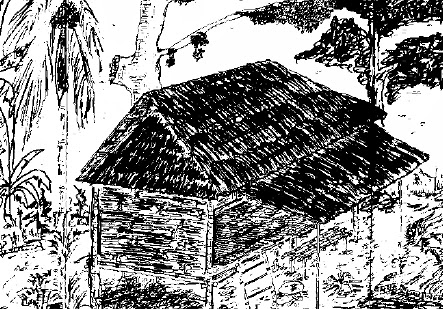
Previously been stated that the youths and girls have a habit of sleeping in groups outside his parents' house. The house specialty beds for girls called ‘bagas podoman', whereas a place to sleep for the youth called 'sopo podoman'. Usually the girls went to their podoman bagasse at around 20:00 pm (evening) and at dawn they returned to their homes to help her housework and also help their parents work in the fields or in the field, and similarly as with the youth. It may be said that almost all the necessities of life for youth and girls are still covered by their parents.


Figure. Sopo Podoman.

It is not considered appropriate when a girl wandering around or just go somewhere alone. Because such behavior can lead to prejudice in society. When a girl is about to leave the house for example to meet with his friend, he was accompanied by a 'inang' (mother), 'etek' (mother 's sister), 'bouk' (father 's sister), or at least not by 'anggi' (sister) his own. When outside the house, the girls would not normally pass through the gathering places men like 'lopo' (coffee shop) or 'sopo podoman'. This is done to maintain her dignity so that citizens do not view it as 'bujing-bujing na urgit ' (flirtatious girl). From the other side , the clothes worn by the girls pretty decently as they closed on the head with 'busaen' or 'songkok' (veil), while the body and feet wrapped with brackets clothes (overalls) and 'abit' (sarong flower patterned).

Instead the movement of young people arguably freer than girls. At certain moments the young man often seen in schools for example, when they 'mardalan-dalan' (streets) in the afternoon, and at night they gather in 'sopo podoman'. In the past, the appearance of youth daily always wear 'kupiah' or 'lobe' (cap) and not to forget also a 'abit kaung' (sarong patterned straight lines), dressing on the shoulder or wrapped around the waist. They are usually dressed 'gunting cino' (Chinese style clothes) and 'saraor panjang' (trousers). In addition, each youth generally have a 'piso balati' (dagger) that much use for them such as to make wind instruments 'tulila' or make a 'lubang pangkusipan' to 'markusip'.

Although the movement of socially 'na poso na uli bulung' constrained by custom are quite strict, but there are some occasions that allow them to interact that can be divided into three forms of activity. First, is a joint activity with other community members as the event ‘marburangir’ ('paboru-boruon') in the house before the groom-traditional wedding ceremony held a few days later. Second, is the activity of young people in filling their leisure times like the show 'mangarabar'. And third, is the interaction of young people in dating activities confidential, ie 'markusip' (‘date’).


Figure. Bagas Podoman.

The presence of Tapanuli cinema around 1960 in Kotanopan and Panyabungan have made a lot of changes in the association of young people in Mandailing. People who watch movies in the theater, both men and women, both young and old, together to watch a movie that was imported from abroad, but the seating is segregated between men and women, where women are placed on the back , and the man on the front. The films they love generally comes from the India (Hindustani Film) with songs lilting seduction and romance stories -blue. In addition, especially the men generally also like cowboy films of the Americas.

In line with that, came the dramatic arts performances ('theatrical') and music (called 'marband'), which is often also interspersed with ‘marlawak–lawak’ (jokes, comedy) at the time of Eid (called 'Ari Rayo'), Independence Day (August 17), and the National Education Day (May 2) at ‘Pasar Kotanopan’ and ‘Pasar Panyabungan’ the event name ‘Pesta Taman' (Garden Party). The intensity of such entertainment is more incentive to take place from year to year, which makes pargaulan youth in Mandailing more liquid and open, so that the old traditions such as 'markusip', 'marburangir', and 'mangarabar' they have left because it was considered obsolete (ancient).

Since the 1980s, the young people have been accustomed to doing Mandailing 'marmayam', 'marlancung', or 'raun' (picnic) to places of special relationships among them, such as 'Paronasan' in the Maga - Kotanopan and 'Sipaga-paga' in Aek Godang- Panyabungan. There, they are available all day while 'dating' . At this time , young men and women have often looked Mandailing hand in hand together in public transport and roads, all the more so when the 'ari poken’ (day of the week) in Kotanopan (Saturday) and Panyabungan (Thursday). Even sometimes the youth ( 'poso-poso') came for ‘mangepek’ {‘tease’) the girls, and they also seem familiar eating ie ‘pocal’, noodles, cakes moist collectively jokes together while having a good time at the point of sale (called 'parjagalan') like 'snacks' in the week it was quite crowded. Such a situation continued until now. However, it should be noted that even though they're quite intense interaction and open , young men and women in Mandailing while maintaining the boundaries of decency and morality in accordance with the customs and norms of their religion. [EN]


Entri Populer

Total Tayangan Halaman