DUALISM IN UNITY: THE
CEREMONIAL MUSIC
OF THE MANDAILING RAJA
TRADITION
This article is an attempt to
reconstruct the role, aesthetic meaning and practice of pre-Islamic ceremonial
music in Mandailing na Menek societyl
during the period in which the raja (chieftain) institution was still
politically significant, taking the village complex of Pakantan as the
focus of investigation.2 It deals with but one part of the musical
culture, namely, the three types of ceremonial orchestras, seen in their
traditional religious context. It makes use of present-day musical evidence,
nineteenth century colonial reports, and contemporary expressions of the old
philosophy, art and religion, especially as expressed by the visual art design.
Pakantan is a relatively isolated complex of
hamlets in the mountains near the provincial border between North Sumatra and
Minangkabau. It is one of the few Mandailing villages where the pre-Muslim
culture is still alive and well,3 coexisting as it does with Muslim
and Christian cultural expressions. Despite some differences of detail,
pre-Muslim music and art in these culturally active villages have an overall
unity of style, repertoire and ensemble type.
Before the advent of Europeans to and
the Islamization of the area from the early nineteenth century, the lives of
Mandailing people revolved around a system of rituals led by the sibaso (shaman) and honoring, above all,
the supernatural beings and the raja. As leader of adat (traditional customs
and law) and owner of the pusaka (heirlooms
of the ancestors), the raja was the ceremonial, administrative and judicial
head of the small, local community, members of which lived in a complex of
villages. The raja's grazing lands supported herds of buffaloes which were
sacrificed at important ceremonial functions. His "great house" (bagas borlang or bagas na godang) was frequently situated in a high position in the
village complex, enabling his household the use of clean water from the stream
which ran, like the main streets of the settle- ment, down the slope past the
house. His symbolic color was gold, which contrasted prominently with the traditional
Mandailing color system (bona bulu)
of white, black and red. One of his many functions was to preside at rituals
and interclan meetings in a decorated, open- walled pavilion (sopo godang or sopo gordang) situated in a high position in the village. This
pavilion contained an orchestra (gordang
sembilan) comprising nine drums plus metal percussion and double-reed wind.
And when the raja died, he was entitled to a large-scale funeral at which many
buffaloes were slaughtered and the highest orchestral status symbol--the
gordang sembilan-- was played. Only the raja or his descendant could give
permission for buffalo sacrifice and gordang
sembilan performance, which were reserved for great ceremonial occasions
(horja na godang). At small ceremonies (horja
na menek), only lesser animals such as goats and chickens were allowed to
be consumed and the two-drum gondang
orchestra played.
From the early nineteenth century
onwards, the raja system began gradually to decline. Muslim proselytization in
Mandailing na Menek began about 1810. Padri forces invaded about 1821 under Tuanku Rao, and the whole area was
converted in time to Islam. The Dutch military entered the region in 1821 and
defeated the Padri movement by 1835,
in which year a Dutch Controleur took administrative and judicial charge over
the area, with Kotanopan its centre.
Gradually, many rajas lost their political and administrative power to the
Dutch, retaining only their ceremonial authority and the trappings of power.4
Despite this, cultural expressions of the raja system are still apparent in the
villages of Mandailing na Menek
today.
In the early nineteenth century, the
people led a relatively isolated and intact cultural existence, divided into
three classes: nobility, commoners, and slaves. They held to a self-sufficient
mystical world view, which pervaded and explained all aspects of experience.
Music, for example, was seen as part of the all-embracing unity; it was
inseparable from religious belief, ceremony, the social hierarchy, the
political and judicial system, and the other traditional artistic expressions,
namely, the visual arts and dance, and all the symbolism associated therewith.
Religious thought and practice were
typically Indonesian in that they were based on a belief in the essential unity
of existence and in the dualistic aspect of reality, which explained the
processes of creation and re-creation. They adhered to animist beliefs, based
on ancestral and other spirit worship and pantheism and associated with the
practice of magic. The concept of dualism in unity is represented in the
continuous geometric designs painted on traditional Mandailing houses
(for example, + + + +
and A A A ; see designs in figure 1),5
and in many other aspects of Mandailing
life. The linga-yoni design of an ancestral stone in a Pakantan graveyard today
certainly represents the sexual unity-duality idea. And the rigid, upright,
unornamented ancestral figures carved in wood on Pakantan's sopo gordang, or in stone, possess qualities of sexual
ambiguity or dualistic unity, and what Holt called (1967:25) ". . . the
enigmatic quality of an embryo," with their relatively large heads and
only vaguely differentiated limbs.
The most complete symbol of pre-Islamic
thought in Mandailing was the artistic design on the gables (tutup ari) of a traditional house. The
design and its attributed meanings varied from village to village, but it was
always based on the idea of dualism in unity. This included the dualism of the earth
on the one hang (as symbolized by the design's overall mountain shape and the
motifs of the buffalo head, the half-coconut shell and the scales, together
with their low positions on the gable, their blackness and their femaleness),
and the heavenly bodies on the other, namely, the sun, moon and stars (together
with their high positions, their whiteness and their maleness). The half
coconut was a symbol of prosperity, hospitality, water, and the earth's
fecundity. The scales were an earthly measuring agent, representing justice,
security and harmony on earth and in the cosmos. But the single most important
symbol was the buffalo, which was represented twice on the gable design, both
as a stylized buffalo head and as a pair of horns at the vertex of the gable.
The buffalo, portrayed in black, was a symbol of the earth and its fertility.
Its moonshaped horns were compared to an umbrella, which protected one from the
heat of the sun. It was also a symbol of vital power, a link between heaven and
earth. For the buffalo was believed to serve as a mount upon which important
deceased people were transported to the world of the spirits. The main
sacrificial animal at important funerals was therefore the buffalo, which was
symbolically linked to the set of drums called gordang sembilan.
With dualistic forces continually at
work, potential instability and overt expressions of conflict were inherent in
all situations, including the artistic and the social. One therefore had the
moral responsibility to subsume conflicting elements into a dame (well-
ordered, harmonious) state. Music, especially ensemble music, reflected the
prevailing philosophical and belief system and exemplified how conflicting
musical-syntactical elements and emotive connotations aroused by the music
could be resolved into a state of musical order and unity.
As in many other parts of Indonesia,
ritual in Mandailing was based on a cosmological world-view and was geared to
the agricultural cycle. The main trans- cendental rites were associated with
death and fertility. Initial contact between human beings and the spirits (tondi) of the ancestors and of nature
were the sets of drums, which played specific invocatory rhythms. Music, with
its precise religious and social-hierarchical conno- tations, played an
integral part in ceremony, which was seen as a means of normalizing a
discordant situation or event.
In the case of a death, a well-organized
series of ceremonial occasions enabled the whole community to come to grips
with the change; traditionally it also meant providing the means for the soul
of the deceased to journey to the next world. In cases where it was believed a
supernatural being had been offended, allowing sickness or other calamities to
occur, the problem was resolved by contacting the spirit world with music on
the holiest of instruments--the drum, under the guidance of a shaman (sibaso) or his representative. After
providing spirit offerings (for example, the masticatory sirih with lime and
leaves of the Piper Betel, fried corn and banana leaf tips), specific cyclic
drum rhythms were played in strictly repetitive fashion, together with
interlocking melodic patterns on the metallophones, a solo wind instrument and,
optionally, a vocalist, the latter two components being governed to a higher
degree than the others by the improvisational whim of the performer. The main
syntactic musical dualism, then, was between the rigidly unvarying tunings and
rhythmic patterns of the drums and metallophones on the one hand, and the
ornamented, intonationally variable, rhythmically libertarian wind and vocal
parts on the other.
**************
The basic orchestral repertoire for all
main ceremonies consisted of five pieces, while six others were reserved for
specific parts of funerals, weddings and morale-boosting ceremonies. All pieces
were playable on the three different grades of orchestra, the choice of which
was governed by the class and social status of the feast-giver. The basic
difference between these three ensembles was the type and number of drums used
and, therefore, the dynamic intensity attained in performance; the orchestra
with the highest status was also capable of sounding the loudest. As the only
distinguishing component of the three ensemble types, the drums were clearly the
most important of all the instruments, both musically and spiritually.9
All three instrumental groups were otherwise identical, comprising a double
reed wind instrument (sarune), an optional vocal part, and a metallophone
section consisting of a pair of relatively large suspended gongs--an ogung
induk or ogung dadaboru ("female" gong of about 48 cm diameter) and
an ogung jantan or ogung pangiring (a "male",
"accompanying" gong of about 43 cm diameter); a small suspended
kettle gong (doal); from two to six hand- suspended, narrow-rimmed, small kettle
gongs of varying pitch (momongan); and a pair of hand cymbals (talisasayap or talisasayak). One can only guess as to why the so- called female
instruments in Mandailing and other parts of Southeast Asia are larger than
their male pair. Perhaps it is because of the linga-yoni connection; the womb
is a large cavity, and the vagina a potentially large cavity, which may be
penetrated by the relatively small linga. "The penis is the small part of
the body that penetrates deeper into Mother Earth . . . than any other part of
the body" (Roheim 1972:325).
The nine drums, attached to the low wall
of the sopo godang (or another
traditional house), were beaten by five performers with a drumstick in each
hand at a thunderous intensity.10 In tune with the dualism in unity
idea, the drums were arranged in four "sexual" pairs (with the larger
drums designated as the "female" and the smaller ones
"male"); plus a single drum (enek-
enek, meaning "the little
one", or "the child") to represent the unity (or product) of
each pair (see figure 1). The
largest, leading pair of drums was called jangat
(literally, "to do something with pleasure"), while the second
largest pair was called undong kudong (meaning "beginning to sound");
the middle pair was called padua
("the second") and the next smallest the patolu ("the third"). The undong kudong usually begin a
piece, followed by entries by the padua and patolu, then the jangat comes in with its largely
syncopated rhythmic variations, and finally the enek-enek enters with its relatively free variations.
Pakantan musicians say that sets of
gordang have always been made up of an odd number, just as the number of
buffaloes sacrificed at a ceremony must be 1, 3, 5, 7, or some other odd
number. But informants do not care to say how old the practice of playing nine,
as opposed to five, or seven, gordang might be. Nor does the literature
elucidate this point. In 1846, Willer wrote that he had seen a set of drums of
various sizes hanging in the hall of a headman's house, plus a valuable set of
gongs and cymbals, and a sarune, but he did not specify how many drums
constituted a set.11 In 1895, Ris described an orchestra consisting
of gordang "with nine different tones", plus an "agoeng", a
set of "momongan", "talisasajah" and a "saroenei" (1895:532). We know for
certain, then, that the gordang sembilan
developed over a considerable period of time, culminating at least as long ago
as the end of the nineteenth century, but presumably long before that, in view
of the time it would normally take for such ensemble types to develop and
become musically and symbolically established in social life and in the overall
world view of a group of people.
It is very probable that the
nine-gordang set in Pakantan was an enlargement of a seven-gordang set; indeed,
sets of seven gordang (gordang pitu)
are still said to exist in some areas today. The names of the second and. third
smallest pairs of drums in the gordang
sembilan--padua ("the second") and patolu ("the
third")-- suggest that the undong kudong were once the largest pair, the padua the second largest and the patolu the third largest.12
At least as early as the latter part of the nineteenth century, then, but
possibly long before that, a pair of large gordang called jangat were probably
added to the set of seven gordang,
without changing the original names of the drum pairs.
As each single drum was supposed to
represent (according to some Pakantan
elders) one clan or subclan, the addition of a pair of drums was seen as
symbolizing the acceptance of two new clans or subclans under the raja's
jurisdiction. Thus, the gordang lima (an orchestra with five drums which is
still occasionally played today for ceremonies involving magic, see figure 2)
represented an early stage in the settlement of Pakantan, the gordang pitu a
later stage, and the gordang sembilan the final stage of clan settlement. Five
of the nine single drums in Pakantan are said to represent the Nasution, Lintang, Hasibuan, Kotalanca and Hutagambir clans, while three drums represent the dominant Lubis clan, including the Lubis Hutanopan, Lubis Singasora, and one other subclan; and one drum represents the
clan of the common overlord of them all--the raja (or, today, his descendant and representative), who must also
be a member of the Lubis clan, which
dominates Pakantan society.
The gordang
sembilan was originally reserved for great ceremonies given by or for the
raja, since only he was entitled to and could afford to sacrifice the buffaloes
necessary for an important ritual occasion. The decision as to the appropriate
ceremonial level for a prospective feast-giver was, like other important
communal matters, decided at a formal meeting of clan elders (namora natoras) in the sopo godang, presided over by the raja
who sat on his special layers of mats on a raised platform, with a protocol
officer loudly calling out stylized announcements during the proceedings.
Approximately from the early twentieth century, rich merchants were sometimes
given permission to sacrifice buffaloes, wear relatively high grades of
traditional dress and ornaments, and employ gordang sembilan ensembles for
their families' weddings and funerals.
The central ceremonial occasion during
the hey- day of the raja institution was the funeral, which was a long series
of events intended to help the deceased reach the land of souls.13
In 1783, Marsden described the funeral of a Mandailing raja (reprint 1966:387-9):
"When a raja or
person of consequence dies, the funeral usually occupies several months; that
is, the corpse is kept unburied until the neighboring and distant chiefs or, in
common cases, the relations and creditors of the deceased, can be convened, in
order to celebrate the rites with dignity and respect. . .
When the relations and friends are
assembled, each of whom brings with him a buffalo, hog, goat, dog, fowl or
other article of provision, according to his ability, and the women, baskets of
rice, which are presented and placed in order, the feasting begins and
continues for nine days and nights, or so long as the provisions hold out. On
the last of these days the coffin is . . . surrounded by . .. 'howling
ululantes'14 . . . whilst the younger persons of the family are dancing near
it, in solemn movement, to the sound of gongs, kalintangs,15 and a kind of
flageolet; at night it is returned to the house, where the dancing and music
continues, with frequent firing of guns, and on the tenth day the body is
carried to the grave, preceded by the guru or priest . . .
Mr. Charles Miller mentions his having
been pre- sent at killing the hundred and sixth buffalo at the grave of a raja,
in a part of the country where the ceremony was sometimes continued even a year
after the interment; and that they seem to regard their ancestors as a kind of
superior beings, attendant always upon them."
When a raja died, the populace was
informed of the fact by repeatedly beating a pair of gordang jangat to the rhythm called bombat:
Sometimes the drumming was intensified
by gunshots. This practice was in contrast to that accompanying the death of a
free commoner, which was marked by the rhythm.
played
on a single gordang, tabuh (a long drum in a mosque), or gong.16
In the following gondang notations, seven single timbres are produced, including
five right-hand sounds, namely the tampul
(a , literally, a "blow", beaten with a stick in the performer's
right hand), a very loud tampul ( ),
a sound made by beating the shell with the stick ( • ), a sound made by beating
the right hand drum head ( ) ), and a sound made by the fingers of the right
hand playing near the head rim (J); and two left hand sounds, namely the topak2 () , literally, "be
born", hand-beaten on the top of the left hand drum head and damped on the
right hand end), and the sound made by the fingers near the left-hand rim (4),
which is damped on the right hand end. Timbres given here are not inflexible,
but are commonly used by Pakantan drummers. Notation symbol for the main gong
(Gl) is J , for the secondary gong (G2), and for the doal.
During the days of funeral feasting,
dancing by members of the community was mostly accompanied by the gordang
sembilan, playing the standard repertoire. But when the raja's corpse was
finally carried in procession to the graveyard, a special "coffin rhythm"
(irama roto) was played, its basic motive ( rJ )R identical to the main motive
in music of the dance reserved for the raja
(tortor raja-raja), which was
normally performed at every ceremony. I The other main motive ( 3 ), with an
upbeat and a unit of two notes, may philosophically be interpreted as being an
incomplete unit as it does not possess a third note, which should be regarded
as a product of the dualism, as in the case of the main raja motive ( i ) (Ex.
1 and 2). Irama Roto was also played at "funerals" for tigers. Just
as the raja was the king of a local settled area, so was the tiger regarded as
the "king" of unsettled areas; therefore, a tiger was entitled to
gordang sembilan music at his funeral. Maneaters frequently attacked people,
especially when disturbed from their haunts by fires lit to clear vegetation.
When a dangerous tiger was caught by a hunting party, or by means of shamanist
practices, he was subjected to the process of judgement, which was originally
pronounced by the sibaso, later by the raja and, currently, in "democratic
fashion" by the whole community led by the clan elders (namora natoras). If the tiger was
condemned for having committed the sin (salah)
of eating a human being, he was punished by being cut into pieces and his flesh
buried or, as it is termed, "planted" below a building (panje muran)
constructed on stilts and used for drying rice, thus transforming his substance
into an agent of fertility. Besides irama roto, the rhythm called "crazy
tiger" (irama sarama babiat) was
played while the sibaso or his representative (bayo dato) performed the tortor sarama, an amusing "crazy
dance", with his fellow dancer serving as chaperon, making sure that when
he entered a state of trance nothing untoward happened.18
Second in status to the gordang sembilan
was the gordang lima ensemble, consisting of five single-headed drums graded in
size (two pairs and a single, small drum) plus the usual wind, vocal and
metallophone instruments.19 As has been mentioned, tradition has it
that its five drums represented the Pakantan population 20 when,
long ago (perhaps in the early eighteenth century), it comprised only five
clans. Until the twentieth century, it was used for musical ceremonies ranging
from the fairly important to the fairly minor, held mostly in the house of the
sibaso or his representatives at the request of his clients. The sibaso
(literally, "the word", one who could read and write magic books and
calendars) was a diviner and healer, a master of the arts of self defense
(poncak sile) and the singing of legendary songs (turi- turian), and an expert
in religious philosophy and white and black magic. He chose propitious days for
all important activities and officiated at ceremonies, usually in the presence
of the raja. When the raja and the elders wished to obtain clairvoyant
information about, say, who would win a certain battle, the sibaso would dance
in a state of trance to the accompaniment of the gordang lima which, it was
believed, could drive out the sibaso's soul (tondi) in order to allow the
ghostly spirits (begu) to enter him and answer the questions through the medium
of his voice. A piece of shredded bamboo attached to one of the drums sounded a
magical buzzing noise as it was played. Th1 ensemble was normally kept in the
house of the sibaso.2l
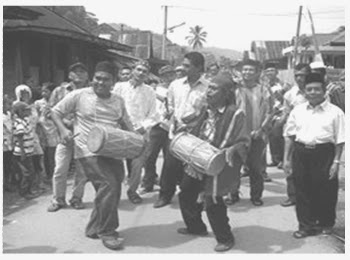
Of the three ceremonial orchestras, the gondang (see figure 3) had the lowest
social status, associated as it was with free commoners and their ceremonies.
Despite this, it produced the most elegant balance of sound of all Mandailing
ensembles. Its two small, double- headed drums, the female slightly larger than
the male, again illustrate the religious theme of dualism in unity. Lacking a
third drum, to make up an odd number, it was, however, philosophically less
complete than the gordang ensembles. The gondang could not, of course, rival
the thunderous sonority of the gordang ensembles, which had the magical quality
of being audible from afar. But it was superior to the gordang in terms of
acoustic balance and clarity of sound texture. Moreover, its relatively subdued
dynamic level allowed the use of the solo human voice, unlike the gordang, the
intensity of which would drown a vocal part. It also possessed a greater
potential than the gordang for musical subtlety and contrast of texture and
dynamics within the ensemble, which consisted of wind and metallophone
instruments and an optional solo voice.
The gondang ensemble was reserved for
small ceremonies at which the only animals consumed were goats, lambs, poultry
and/or fish, which all cost much less than buffaloes. The really poor could not
even afford a gondang ensemble at their weddings and funerals, in which case
the spirits were nurtured only by offerings hanging from their houses. But the
moderately well-off used the gondang for the dancing and mystical rites at
their weddings and funerals. And people of a variety of ranks and degrees of
wealth used the gondang for minor celebra- tions, for example, name-giving, the
first birthday, circumcision, and house-warming ceremonies.
Each musical piece, whether played on
the gondang or the gordang ensemble, was named after its basic (totop) drum
rhythm. For example, the first piece played at a ceremony was named after the
drum rhythm called Irama Jolo-jolo Turun
("the rhythm asking the spirits to descend"). This and other
ceremonial rhythms were largely played in an unvarying manner, since they
served as invocations. If the basic rhythm of a piece were to be varied, it
might not be immediately recognizable to its listeners, especially its
transcendental listeners, and its effect of calling the spirits would therefore
be lessened. Moreover, the repeated, unchanging drum patterns helped provide a
mesmerizing atmosphere in which the sibaso could induce a state of trance,
either in himself or in another mystically gifted individual, who could then
serve as a medium for a transcendental voice. The basic rhythm of Irama
Jolo-jolo Turun, notated here with the set drum timbres as played on the pair
of small drums called gondang, is given in Ex. 3. For a transcription of the
beginning of the piece, see Ex. 4.
The piece was and still is played
slowly, with a small average number of notes relative to their duration and
tempo. Itp short motivic statements mostly contain an anacrusis: I , & PJ ,
and Ja J withP J1 and JrAJ the most frequently used. Tampul-topak combinations
( ) occurred mainly on the first and third beats of the quadruple metric unit,
their added intensity reinforcing the metric beat. When Irama Ideng-ideng (Ex.
5) was played on the set of nine gordang, the basic rhythm heard was the same
as on the gondang, but it was accompanied by loud interlocking patterings on
the other drums.
The relative freedom of the sarune line
as opposed to the rigidity of the other parts exemplifies the syntactic-musical
dualism or dialectic inherent in Mandailing orchestral music. Whereas the drums
and metallophones perform stable, unchanging parts, the sarune line is
whimsically variable in its rhythmic and melodic ideas, intonation and
alternation between long-held tones and ornamental passages.
The second piece played at a ceremony
was Irama Ideng-ideng (Ex. 5) meaning "rhythm praying that the spirits
settle in". Its rhythm was based on the same motives as in Irama Jolo-jolo
Turun, with J1 and PJJ the most prevalent. While the A sections of both Jolo-
jolo Turun and Ideng-ideng are rhythmically the same, the B sections have a
different series of motives and the same four timbres are used in each. The
double drum sounds and reinforce the meter, occurring mostly on the accented
eat. As in all mystically potent pieces, tempo is slow.
Only in the third piece did communal
dancing begin, led by the host (suhut) and followed by his mora (head of the
relevant wife-giving clan). The piece is called Irama Alap-alap Tondi (Ex. 6),
meaning "rhythm calling the spirits". In this piece, as it is played
today, only three motives ( J , @d and #JP1 ?a d ) may be used, in variable
sequence;24 and drum timbres are restricted to only two--the tampul and the
topak. This strict prescription of allowable motives and timbres, together with
its slow tempo, complies with the piece's function as a magic invocation.
But the simplest, shortest and most
aurally recognizable of all rhythms is the Irama Raja-raja (Ex. 7) meaning
"headman's rhythm", (a transcription of part of which appears in
Kartomi 1977:27). It consists of three motives ( , . and , d ), of which the third must be
repeated. As in Irama Roto, which has already been discussed, only two timbres
are used--the tampul and the topak. As the rhythm most strongly bound by
traditional musical regulations, it was regarded as being very potent
mystically. In tune with the tradition of respect for and subservience to the
office of raja, the rhythm was almost never varied in performance.25 In a
recording made by the author, it was always played with a slow tempo. Its
motivic character and restricted timbres closely resembled the previously
discussed Irama Roto, which is not
surprising, as Roto was the rhythm played at a raja funeral.
Irama Raja-raja was also called Irama Saba-saba ("long scarf rhythm"), accompanying one
of the most frequently-performed Mandailing dances--Tortor Raja-raja, led by the raja (or his descendant, today)
together with the inter-clan elders (namora natoras). The raja or his
descendant wore a special raja-style shawl (ulos),
which is an important mystical and hierarchical symbol; it draped around his
neck and reached below his knees on each side. He held the end of the ulos loosely between his fingers as he
danced, moving his body slightly down on the beat, and performing a variety of
hand movements. After some time, an ulos was passed from one respected elder of
the community to another, on receipt of which each was expected to dance.
The first four pieces were the most
mystically powerful of all and, when performed, were easily recognizable by
their drum rhythms. The fifth piece played at a ceremony, Irama Tua
("blessings rhythm") Ex. 8, is often performed with a beautiful tenor
vocal part, the text of which requests blessings from the spirits. It has a
moderately fast tempo. It possesses the most complex gondang parts of all in
terms of its combinations of rhythm and timbral characteristics. The two
gondang play different rhythms, one unchanging (totop) and one varied (mangalaluhon).
A comparatively wide range of gondang
timbres (N, 7, j and ) ) is used; that is, in addition to the use of the tampul
and topak, the drum stick is used to strike both the head ( J ) and the shell (
4 ) of the drum. The shell-tapping mainly serves the rhythmic function of
off-beat interlocking.
The young unmarried people then had the
opportunity to take part in the ceremonial dancing, to the accompaniment of the
piece Irama Mandailing (Ex. 9). Choice of partners was strictly regulated by a
married woman (raja bujing), who saw to it that a woman did not dance with a
man of the same clan, since marriage within the clan was taboo. In the dancing
the women were disembar (protected) by the men, who danced in manyembar
fashion, that is, encircling the women "like an eagle its prey". A
woman's hands, holding the edge of the long shawl (ulos) around her neck, were
allowed to be raised to thigh, waist or chest level and no higher, while a man
could raise his hands up to and even higher than his shoulders.
As a dance (tortor) of great age and
functional importance, Tortor Mandailing was performed with a slow tempo. Its
motivic structure is strongly related to Irama Raja-raja, its similarity lying
primarily in the opening group of repeated notes ( 0mlm 1 2 and its use of the
motive J " J J ). But much more rhythmic variability is allowed in this
piece than in Raja-raja, which should be regarded as the strict prototype of
Mandailing rhythm. Moreover, it contains greater timbral variety, using ? , J ,
? , and the combination, which is beaten mainly on the downbeats.
Before the end of the ceremony, the
dance of the raja's wife (Tortor Inanta
Soripada) was performed. Unlike the other dances, this one is now almost
obsolete because raja wife descendants are not counted in Mandailing's
patrilineal lineage. After that, the young unmarried people continued dancing
at a ceremony to such rhythms or pieces as Irama Sampedang, and the stately Irama Sorop- sorop Ombun ("dew
falling") rhythms. And the popular dances Tua and Raja-raja were
usually repeated before the dancing stopped.
The other well-known rhythms were
associated with specific parts of wedding ceremonies and morale- boosting in
times of war. The special procession music played when a bride was brought
"to the stream" (Kehe tu Aek
or Boru tu Aek), or during a bridal
procession to the husband's village, was called Irama Boru Tu Aek or
Mangalo-alo (literally "glittering") in the former case and Irama Sampedang in the latter. The bride
and her entourage were brought in procession to the local stream to be
ceremonially shown the proper place where, as a married woman, she was
henceforth to bathe.
Unlike the ceremonial rhythms, four main
rhythms were designed to be played at a fast, exciting pace. Irama Katimbung,
for example, was said originally to have derived from the rhythms of water-play
when children (according to one story) or the daughter of a raja and her
friends (according to another, pro-royalist story) were playing in the river.
In this popular game, one makes sounds of varying pitch and loudness by forming
air pockets in the river water with one's palms, thus causing the air in the
hollows to explode. Each player produces a variety of rhythms in an
interlocking manner. Katimbung, like
ciblon in Java, is an onomatopoeic name for this game as well as a title for
the piece of music based on its rhythms.
Another fast rhythm was Irama Porang,
played in order to raise the morale of troops before they went to war (porang).
"Batta country," Marsden wrote (1783 (1966): 374), was ". . .
effectively. . . divided into number- less petty chiefships, the heads of
which, also styled rajas, . . . are . . . extremely jealous of any increase of
their relative power, and on the slightest pretext a war breaks out between
them." Especially since a very small number of soldiers took part in
Mandailing wars, morale-boosting was an important preliminary activity.
One of the main gondang rhythms is the fast exciting Poncak Kutindik, used in
morale-boosting and tiger funerals to accompany performances of the local
versions of the art of self defense (poncak).
Several types of poncak were (and
still are) popular, distinguishable primarily by the stylized fighting movement
(gorak) characteristic of each and by
the presence or absence of a weapon. In the most dangerous type, one opponent
tries to get hold of the knife brandished in the other's hand, at the same time
fulfilling the aesthetic demands of the dance by performing the characteristic poncak movements (gorak jago-jago) with elegance, and beginning and ending with a
stylized bow of respect (sombah) to
each other and to the audience.
CONCLUS ION
Belief in the unified and dualistic
nature of existence, as reflected in the tutup
ari design, is the basis of Mandailing musical aesthetics and practice. The
raja, who controlled the main ritual
symbols--the drum and the buffalo--served to promote social cohesiveness, and
symbolized the unity of the life style and belief system.
The composition of the three basic
orchestras reflects the idea of unified dualism. Drums and gongs occur in
pairs, plus an extra instrument in some cases to represent the common factor or
product of the dualities. The five, seven and nine-gordang ensembles also
reflect the unity of the village, where the number of drums used represents the
number of clans living in the home environ- ment, just as the elders in the
sopo gordang meetings numerically represent their clans.
Social conflict can be solved by ritual
contact with the spirits through invocatory drum rhythms and the actions of a
mystically gifted individual. Like the buffalo, the drum is the link between
the human and the spirit world.
The most mystically potent rhythms or
pieces have unvarying timbral and rhythmic drum patterns, while the less
powerful rhythms or pieces have variable drum patterns and fast or moderately
fast tempi. Syntactically, the music is characterized by rhythmic, melodic and
intonational conflict, which is subsumed into a congruous, unified overall
sound. Emotive connotations aroused by the various rhythms or pieces of the
repertoire, such as sorrowful feelings when hearing Irama Roto, are also
resolved into a harmonious whole through the playing out of the musical and
ritual process.
NOTES
1. The
Mandailing region of South Tapanuli, in the province of North Sumatra, is
divided into two main areas: the fairly rugged Mandailing na Menek (literally,
"Small Mandailing") area, namely the upper, southern part of
Mandailing, North Sumatra, which comprises the Muarasipongi and Kotanopan
districts; and the rich alluvial plains of Mandailing Godang (literally "Great
Mandailing"), comprising the northern Mandailing plains which consists of
the Padangsidempuan district.
2. An
overview of the musical culture and discussion of specific musical styles is
yet to be written, though a brief article exists (Kartomi 1977). Pakantan's
non-ceremonial music includes a large vocal repertoire and many types of solo
wind and bamboo instrumental music, which are performed on intimate courting
occasions and in work, child- caring, story-telling and other situations. An
important layer of the musical culture is associated with Islam; it includes
dikir (religious choral chant) with dance movements, accompanied by rapano
(frame drums), and berzanzi (songs of praise).
3. Those
few villages are, almost without exception, inspired in their musical activity
by an elder from inside or outside the village, who is largely responsible for
the recent cultural revivals. For example, a Medan academic -- Dr. A.P.
Parlindungan -- has actively supported and promoted the pre-Muslim culture in
his family's place of origin--Pakantan. Likewise, a raja descendant-- Raja
Junjungan of Medan--has revived the cultural expression in his hometown, Huta
Godang. And the village head in Tamiang promoted local music and dance, partly
in emulation of the lively Javanese cultural scene which he had witnessed
during a long sojourn in Java.
4. For
a summary of Padri and Dutch activity in early nineteenth century Mandailing,
see Castles 1972:19-24.
5. Mandailing
house decorations consist only of geometric and animal designs which, according
to van der Hoop, are the most ancient of all Indonesian designs, preceding the
vegetable designs which had entered the region with the advent of Hinduism (see
van der Hoop 1949:23). Hindu-Buddhist influence was probably exerted on
Mandailing culture several centuries ago, from the period of temple building at
Portibi, Padang Lawas, which Mandailing people claim to be their ancestral
home. But vestiges of Hindu-Buddhist influence are very slight today.
6. The
Javanese gunungan (kayon) and the Mandailing tutup ari, which are the most
significant symbols of Javanese and Mandailing thought respectively, are both
mountain-shaped.
7. Ancestors
of the Indonesians worshipped the buffalo as a sacred animal in the latter
Stone Age (neolithicum). The motive of the buffalo head still symbolizes the
fruitful earth and protection against evil (see van der Hoop, ibid: 130).
8. "By
the shape of its horns the kerbau (buffalo) is related to the moon" (ibid:
130).
9. The
drum was also regarded as a sacred instrument in the entire Batak area and in
other parts of Southeast Asia, for example, in Central Thailand (see Morton
1976:68). In Java today, the gong is the most honored instrument, but the drum
was probably a holy instrument there long before the gong existed. The oldest
known musical instruments in Southeast Asia are the revered Dongson kettle
drums, which were probably played at religious rain-making ceremonies.
10. In
Pakantan today gordang are played consistently loudly (gogo), but elders claim
that in the past they were performed in a more haripian (peaceful, quiet) way,
in order to attract benign spirits. People in the village of Tamiang today
alternate between loud and soft gordang playing and support the statements
about the history of dynamic levels as given by the Pakantan elders.
11. "De instrumentale muzijk bepaalt zich bij een stel trommen van
verschillende grootte, dat men in het voorhuis van den pamoesoek ziet hangen;
een dergelijk stel gongs en bekkens, dat een voornaam gedeelte van den rijkdom
der hoofden uitmaakt; de seroeneh of hobo..." (Willer 1846:350-1).
12. This
possibility was suggested to the author by L.F. Brakel.
13. A
detailed description of a funeral in the mid- nineteenth century is given in
Willer (ibid: 321 ff). 90
14. Sorrowful
singing by women at a funeral was called mangandung hamatian. This practice has
almost died out because of Muslim bans and the disapproval of Muslim leaders.
15. Kulintang
is a name used in parts of Minangkabau and elsewhere for the kettle gongs
which, in Mandailing, are called momongan.
16. The
same rhythm is still played in Pakantan today to announce a fire or a death.
17. This
rhythm was transcribed from a performance on a two-drum gondang ensemble, but
it is the same as the rhythm of a gordang performance of this piece. The
timbral data is based on work by A.P. Parlindungan. The timbral notation system
used here is an adapta- tion of Parlindungan's system, which was outlined in a
letter to the author.
18. Today
dancers wear trousers and shirts in red, white and black (a dualism of male and
female plus the redness of danger), or simply red, with turban-like headrolls
and an ulos Patani (long, traditional shawl of a type believed in Pakantan to
have originated in Pattani, southern Thailand) around their necks, the ends of
the ulos held by their fingertips while dancing.
19. The
gordang lima ensemble is still played by Pakantan immigrants in the city of
Medan, in a conscious effort to preserve their cultural heritage. But since
contacting the spirits through a shaman does not accord with Muslim beliefs,
the gordang lima and associated mystical activity is, to all intents and
purposes, obsolete in Pakantan today.
20. According
to A.P. Parlindungan (a member of the Lubis clan), Pakantan was founded in the
mid-sixteenth century A.D., because the Lubis genealogical chart documents
members of fifteen generations. Thus, if the child-bearing age of a woman is
said to be seventeen years, Pakantan was founded at least 15 x 17 = 255 years
ago.
21. The
institution of sibaso predated that of raja. In each generation, sibaso and
raja usually belonged to the same family. According to the legendary songs in
Pakantan, the first sibaso was the primal ancestor of the Lubis clan--Na Mora
Bosi, a master metal- smith and mystic hailing from the Bugis region of
Sulawesi, who founded the ancestral village of Hatonga in Padang Lawas (to the
northeast of Mandailing na Menek), from whence his two younger sons -- Si
Langkitang and Si Baitang -- were sent to "the land of gold" (Mandailing
na Menek). Here they defeated and married into the family of the raja of the
local Nasution clan--Na Mora Sutan--who fled to Pakantan. Moreover, a
grandchild of the primal ancestor became known as Raja Mangalaon (after whom a
drum rhythm is named), marrying a Harahap girl; and one of their children went
to live in Pakantan.
22. Inner
tempo is calculated as the number of tones x 60 divided by duration in seconds
(see Christensen 1958: 10).
23. Cf.
the Javanese (Yogyakarta) term tepak, meaning "fly swatter", or a
small sound made by curved fingers on the left head of the drum.
24. Unlike
Jolo-jolo Turun and Ideng-ideng, which in the author's recordings showed very
slight variation in the second metric unit ("bar"), no motivic
variation whatever occurred in Alap-alap Tondi.
25. In
one recording of this piece, the rhythm varies somewhat from the norm in the
beginning, but this was probably because the player was just "warming
up".
26. The
name Batak is often applied to people living in all the non-coastal areas of
North Sumatra province. But few Mandailing people accept that they are Bataks.
They admit that some of their cultural expressions resemble those of the
Bataks, but believe that their ancestry, physiognomy and some cultural characteristics
are distinctive. Muslim Mandailing certainly possesses a different cultural
cast from the Christian Batak areas. REFERENCES CITED Castles, Lance. 1972 The
Political Life of a Sumatran Residency: Tapanuli 1915-1940. Ph.D. thesis, Yale
University.
REFERENCES CITED
Castles, Lance. 1972, The Political Life of a Sumatran Residency:
Tapanuli 1915-1940. Ph.D. thesis, Yale University.
Holt, Claire. 1967 Art in Indonesia:
Continuities and Change. Ithaca: Cornell University Press.
van der Hoop, A.N. J. Th.a Th. 1949
Indonesian Ornamental Design. Bandoeng: A.C. Nix.
Kartomi, Margaret J. 1977 With Bells and
Drums. Hemisphere 21: 21-28.
Marsden, William. 1783 The History of
Sumatra. Kuala Lumpur: Oxford University Press. Reprint 1966.
Morton, David. 1976 The Traditional
Music of Thailand. Berkeley and Los Angeles: University of California Press.
Ris, H. 1895 De onderafdeeling Klein
Mandailing Oeloe en Pahantan en hare bevolking met uitzondering van de Oeloe's.
Bijdragen tot de Taal-, Land- en Volkenkunde Neder- landsche Indid 46:532.
Rcheim, Geza. 1972 Animism, Magic and
the Divine King. (1930) New York: International Universities Press.
Siregar, Ahmud S.S. 1977 Kamus Bahasa
Angkola/Mandailing Indonesia. Jakarta: Pusat Pembinaan dan Pengembangan Bahasa.
Willer, T.I. 1846 Verzameling der
Battahsche wetten en instellingen in Mandheling en Pertibie; gevolgd van een
overzigt van land en volk in die streken. Tijdschrift voor Nedrland's Indid
VIII:2.
~o0o~