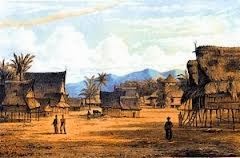
'MANDALA HOLING'
By Edi Nasution
PROLOGUE
Although
ethnic groups (tribal) Mandailing has traditional script called ‘surat tulak-tulak’, and is used to write
the ancient scriptures called ‘pustaha’,
but it is generally ‘pustaha’ not contains 'historical remarks' Mandailing
people. The 'books traditional' ('pustaha') that rather about the matters relating to the science of traditional
medicine, the occult sciences, predictions about the future that are considered
good and bad, as well as predictions about the dream (Pangaduan Z. Lubis, 1986:
43-44). One source of ancient history mentions the name 'Mandahiling' (Mandailing) is a book written by the Mpu Prapanca the
Majapahit era is ‘Negarakertagama’.
Additionally Mandailing name ('tano padang bakkil bandailing') is also
mentioned in the Toba-old classical literature, namely ‘Tonggo-tonggo Si Boru Deak Parujar’ (Batara Sangti, 1977: 278). ‘Tonggo-tonggo’ reads as follows:
"Baen ma gondang ni Ompunta, Tuan Humara-Hiri, Si Humara
Naboru, par-aji tamba-tua, par-aji pulung-pulungan; sinonduk ni Ompunta Sibaso
Nabolon, na marsigantung ditali siubar, na meat di mombang boru".
"Sian tano hondur, tano malambut, tano
hulambu jati, sian tano padang bakkil bandailing, tano siogung-ogung;
parsirangan ni tano, pardomuan ni aek; Sian i ma dalan laho tu ginjang,
partiatan ni Ompunta: Debata Natolu Suhu, Naopat Harajaon tu banua tonga
on".
Disi ma parangin-anginan ni Ompunta 'Siboru
Deakparujar', sideak uti-utian, sigodang ujar-ujaran:
1.Na manjadihon : 'Gana na so boi
tolonon, bulan naso boi oseon'
2.Sian I ma mula ni : 'Dung-dang'
3.Mula ni : 'Sahala'
4.Mula ni : 'harajaon'
5.Mula ni : 'Gantang tarajuan, Hatian
pamonari'
6.Mula ni : 'Pungga si sada iht'
7.Mula ni : 'Ninggala Sibola tali'
8.Sian i ma : 'Boli nii boru muli dohot
si namot ni anak'
9.Mula ni : 'Goar ni bao na so boi
dohonon'
10.Nunga disihataon i : 'Di ninggor ni
ruma, dipagohan di pinggol nia-debata'."
If the Tonggo-tonggo Si Boru Deak Parujar
freely translated and converted into English limited as follows :
Tonggo - Tonggo Siboru Deakparujar
Play
the drum of our master, ‘Tuan
Kumarakumari’, ‘Si Kumara ia a women’,
‘par-aji tamba tua’, ‘par-aji-ramu-ramuan’; husband of master
we ‘Sibaso Nabolon’, which relies on
‘siubar’ rope, which is perched on ‘mombang boru’.
From
the land of the valley, a true gray ground, from the ‘tano padang bakkil Mandailing’, famous ground, like a melodious
voice, separation rather than land, rather than water meeting : “From there the
road to the top of the stairs, where we dropped rather than “Empu’ : ‘Debata Nan Tiga’, ‘Nan Tiga
Segi’, ‘Nan empat kerajaan’, to
the middle of the continent.
That's
where we ‘Si Boru Deak Parujar’, which
many ingenious, resourceful:
1.Which mandates : "There should be eating oath , should not deny
pledge"
2.The origin : "Trust"
3.The origin : "Sahala"
4.The origin of the "kingdom"
5.The origin : "Bushel measurement, scales of truth"
6.The origin of "Rock - a bundle of shavings"
7.The origin of "Pirates like splitting strap"
8.That's where the origin : "Acceptance of purchasing over the marriage of
girls for marriage and honesty payments boy"
9.The origins : "The name of ‘besan’
that should never be called "
10.It has been made: "In horses native Batak house, plugged in ear ‘Batu Barani’ and 'di pinggol nia-debata'."
We
do not know when Tonggo-tonggo Si Boru
Deak Parujar was created or invented. All we know is that Siboru Deakparujar are mythological
figures in Toba culture. According to the Toba mythology, Si Boru Deak Parujar
was the daughter Debata Mulajadi Nabolon,
which commanded-His down from the 'continent over' to the 'central continent'
bring a handful of soil, earth to forge over the ocean.
But
in attempting to forge the earth, Siboru
Deak Parujar interference from Naga
Padoha (‘Raja Padoha’), but finally he managed to complete the task was.
Then Debata Mulajadi Nabolon decreed Si Raja Odap-odap down to earth to become
the husband Si Boru Deakparujar. Of
marriage Si Boru Deak Parujar with Siraja Odap-odap, was born a son named Siraja Ihatmanusia, and a daughter named
Si Boru Ihatmanusia. Both brothers are
married and then got three sons. Each Si Raja
Miok-miok, Patundal Nabegu and Si Raja Lapas-Lapas. Of descent Si Raja Miok-miok later Si Raja Batak, which is seen as the
progenitor (ancestor) of the Batak.
According
to Batara Sangti, 'tonggo-tonggo' is
arranged in a poetic prayer and pronounced large and small serving time (1977:
270). In Tonggo-tonggo Si Boru Deak Parujar
clearly stated that “tano padang bakkil
Mandailing” famous ground, like a melodious voice ‘gung’ (gong sound
melodious usually attract attention and can be heard up to distant sites). From
there (from the ground Mandailing) way to the top, 'perturunan' (point down) of our master: Debata Nan Tiga, Nan Tiga
Segi, Nan Empat Kerajaan, to 'the
middle of the continent' (to earth). Based tonggo-tonggo (prayer) is, it is clear that since time immemorial
(since the mythological figure Si Boru
Deak Parujar), the Toba (Batak) has recognized the notoriety Mandailing
ground. More important than that, Tonggo-tonggo
Si Boru Deak Parujar also clearly states that the land is where the stairs
Mandailing way to the top (heaven), and dropped into a god (Debata Nan Tiga) to 'the middle of the
continent' (earth) this.
Furthermore 'tonggo-tonggo' states also that
"therein" (on the ground Mandailing) Si Boru Deak Parujar banc. Thus it can be interpret that Si Boru Deak Parujar possibility on the
ground once it was exactly Mandailing down from heaven. For his tonggo - tonggo
mention "out of it ( from the ground Mandailing) stair way to the top
(heaven)". Therefore , it is also the possibility that in the ground
Mandailing, Si Boru Deak Parujar
precisely mate with Si Raja Odap-Odap.
Furthermore, their offspring were born and flourished in the area. Then the
hypothesis can be stated , that after the descent Si Boru Deak Parujar and Si Raja
Odap -Odap growing in the ground Mandailing, the next generation of their
descendants, such as Si Raja Batak (fourth generation descendants of Si Raja Miok-miok, or sixth generation of
descendants Si Boru Deak Parujar and Si Raja Odap-odap) move to another place
to leave the land Mandailing and go to the land Toba. Then in that place he
develops. In other words, based on the interpretation of Tonggo-tonggo Si Boru Deak
Parujar the Siraja Batak
ancestors, starting from Si Raja
Odap-Odap and Si Boru Deak Parujar
up to Guru Tantan Debata, the father
of Si Raja Batak alone , after big
then leaving the area (Mandailing) and go to another place that is 'tao Toba'.
‘MANDAILING’ AND 'HUTA ILING'
Mandailing is an 'open area' and the
attitude of the population is also quite open (‘open society’), so much visited
by the tribes (nations) from the other parts of the world, more or less the
same situation with Simelungun region that also located in northern Sumatra. In
this case, Juandaha Raya Purba Nasuha (2008) in the online media KASKUS among others wrote as follows: "Ethnic
groups are historically Simelungun Old Malay descent (Proto- Malay) rear of
India which spread to an area called now Simelungun after undergoing a process
of transformation , assimilation and integration of the various aspects with
other tribes who come into contact with the ancestral Simelungun. During its
development, the first ancestor Simelungun after settling on the east coast
gradually move inland's due to the invasion of other nations successive
coming hold expansion into homeland areas (ground water) Simelungun Simelungun. ... So that people today there who claim their ancestors came from Pagarruyung
in West Sumatra, Samosir-Tapanuli, Aceh, Gayo- Alas, Pakpak and even from
India and Java. So Simelungun into ethnic neighborhoods that have already
integrated the various tribes that difficult to decomposed and traced back to the
beginning stages".
Just as in Mandailing, in Simelungun
there are also many ‘huta’
('village') such as: Huta Manik Tomok, Huta Saing Dolok Silau, Huta Mariah, Huta Tano,
Huta Siallagan, Huta Harangaol, Huta Urung, Huta Bayu (are wrong ‘nagori’ existing one Simelungun), and Huta iling. In Simelungun language, the word 'iling' means 'loud noise', while the
word 'ling' in Mandailing,
meaning "a high-pitched voice or a loud", something like the sound of
the sound of birds 'tarias'
('serindit') males.
In this connection, according to
Basyral Hamidy Harahap (2013), the name 'Mandailing' is derived from
Sanskrit vocabulary is 'mandala' and 'iling'. Vocabulary word 'mandala'
means 'area', 'region', 'war scene', while 'iling' means 'oblique'
is associated with the "contours of the land in the form of a gently
sloping hill " (called : 'Dolok'), slopes , valleys and plains which
flowed a river, like a village in the district Kingdom, Simelungun named Huta
iling whose coordinates are 2o56'0" North Latitude and 98o53'0"
east longitude, about 21 kilometers west of the city Siantar between Panai and Raya. Meanwhile, according to Warneck (1977 : 27 , the word 'iling' means
zursei geneigt means 'ramp'. And in Canto XIII to Nagarakertagama book (
1365 ), Mpu prapanca mentions that 'Mandahiling 'is one of the '
neighborhood of the archipelago which is quite important in the past' (14th
century). name 'Mandahiling', in Canto XIII Negarakertagama, with many countries in the name of Sumatra written by Mpu Prapanca as 'vassal state' of the Majapahit Kingdom as follows : "Lwir ning nuasa pranusa pramuka sakahawat
kaoni ri Malayu/ning Jambi mwang Palembang i Teba len Darmmacraya tumut/Kandis,
Kahwas Manangkabwa ri Siyak i Rekan Kampar mwang Pane/Kampe Haru athawa
Mandahiling i Tumihang Perlak mwang i Barat".
Indeed, in the book of the Negarakertagama no other details about
the Mandailing except as a 'vassal state' of the Majapahit Kingdom. However,
with a name wrote Mandailing there exists an authentic historical evidence that
the 14th century has been recognized as one of the 'vassal state' of the
Majapahit Kingdom. Unfortunately, the notion of 'vassal state' in this case is
not so clear because it means there is no further explanation.
‘BANUA HOLING’ AND ‘SERE’
Beliefs about the origins of the
leluluhur (ancestors) who came from a distant place ('migrants') to the island
of Sumatra was not only dominated by ethnic Mandailing. There are a number of
other tribal claiming to come from areas far beyond the island of Sumatra, such
as community Inderagiri Kuantan in Riau, Kerinci communities, tribes
Simelungun, Karo (especially Merga Sembiring), Pakpak, and also people Barus on
the west coast of Sumatra island north.
Mandailing tribal peoples who inhabited
the southern part of the province of North Sumatra (District Mandailing Natal)
is reported to originate from Munda, which is a region in Central India. They
have moved on to a 6-century, as the nation was hit by an attack from Iraq
Arayan expand their influence. After crossing the Himalayas ('Dolok Malea'),
then they settled briefly in Mandalay, the Burmese ancient mother country. It
is probable that Mandalay name itself comes from the word that follows the
accent 'Mandailing-Burma'.
Once again they had to bepindah because
of the upheaval of the tribe in Burma are often fought. At that time, they
crossed the Strait of Malacca, which at the time was not a huge ocean, very
understandable that at that time in certain parts of Sumatra and the Malay
Peninsula Land only separated by a small strait.
After the Munda has managed to cross the
'small sea' is. then established a kingdom in Batang Pane, Portibi-Padang
Lawas. Allegedly this event is expected to occur at the end of the 6th century.
Munda kingdom holing in Portibi has become the renowned and expanding conquests
were largely up to the coast of Sumatra and the Malay. This situation raises
ire Maharaja Rajenderacola, then he attacked Munda kingdom holing and other
coastal states in the 9th century. Paramilitary roops Munda (Holing) kingdom led by Raja Odap-Odap been killed by by Rajenderacola and power throughout the region
Batang Pane. Her fiance is 'Si Boru Deak Parujar' has crossed 'Dolok Malea' (i.e. climb the Himalayas by his ancestors) by grasping the 'lump of soil' in Portibi
to establish a 'royal' ('banua') new (see: Tonggo-tonggo Si Boru Deak Parujar
as classical literature on tribal Toba-old)
After 'Mandala Holing' kingdom up in Portibi conquered, then birth is also 'second empire' on the island of
Sumatra in built in 'Pidoli Dolok' (a small town near the capital of Madina, Panyabungan as now) Mandala Holing recognized as a kingdom, which means
'those areas Keling'. At that time, they still are Hindus to
worship 'Dewa Siva' ('Shiva'). In the 13th century, the Majapahit Empire has
invaded into Lamuri and also Mandailing. Once again this has been holing
Mandala kingdom on earth scorched and destroyed. Captive population could not
have run into the woods and 'mixed-hanging' with the natives. Then formed 'Marga Pulungan' which means 'na i pulung-pulung'. In the
14th century and the 15th, 'Pulungan Highways' has established three 'Bagas Godang' ('royal palace') over the three hilltop, but the kingdom is no
longer a great empire, but rather 'just a royal village' ('huta'), in Huta Bargot, which is located not far from Panyabungan.
So it can be said , according to Z.
Pangaduan Lubis (1987), ‘Negri Mandailing’ that existed before the 14th
century. Because before its existence is recorded in advance of course
Mandailing already exist. But when the 'State Mandailing' start standing is not
known exactly. But because Mandailing name in the book is touted with many
names including 'Pane' and Padang Lawas country' in Sumatra, presumably 'Mandailing country' have started there in the 5th century or before. Because the 'Kingdom Pane' has been mentioned in Chinese records in the 6th century. Such
conjecture can be connected with the historical evidence in the form of temple
ruins located in close Simangambat-Siabu. Temple ('cai') is the Shiva temple
that was built around the 8th century. Is the 14th century Mandailing is an
unknown kingdom. Because in the book Negarakertagama, Mandailing not
mentioned as a kingdom but as a 'vassal state' of the Majapahit Kingdom. But
the country is mentioned Mandahiling (Mandailing) as a country, there is a
possibility at that time Mandailing is one kingdom. Information regarding the
circumstances Mandailing before the 14th century there was no existence at all
except Shiva temple in Simangambat. However, based on many relics from
prehistoric times and relics from the days of Hindu/Buddhist contained in
Mandailing we can express hypothetical statements, with the following
description:
In Simangambat (near Siabu) are the
ruins of the temple of Shiva (Hindu) of the 8th century. The temple (called ‘cai’ is much older than the existing
temples in Portibi (Padang Lawas) which, according to estimates by experts
built in the 11th century. Given this Shiva temple can raise the question of
why and when the Hindu people from India came to Mandailing which is located on
the island of Sumatra, which they named Swarna
Dwipa (‘Golden Island’).
It is probable that the Hindus came to
Mandailing located in Swarna Dwipa is to seek sere (gold). In the history of
India, there is a statement that says that around the first century AD gold
supplies are imported into India from Central Asia stalled. Because in Central
Asia occurred wars. Therefore, the kingdoms in India are trying to get gold
from other places, from Sumatra/Swarna Dwipa. In this connection, it is
understandable that in the region Mandailing which in the past to the present
in it including Pasaman region there are a lot of gold, so-called tano tano
sere or tano omas sigumorsing. The evidence on this matter an awful lot. So huge
possibility that the destination by the Hindus of India to look for gold in
Swarna Dwipa is Mandailing area, which at the time this area has not been named
Mandailing, who knows what it's called when it can not be escertained.
Hindus who came to the area Mandailing
is derived from the country or the kingdom of Kalingga in India. Hence they are
called Alak Holing or Alak Koling. There is a possibility of them entering the
area Singkuang. Because that is where empty Batang Gadis river at Singkuang quite well known as a 'port'. That is why the place is called Singkuan by 'Chinese traders' which means 'new hope'. Because through this port they used to
obtain various 'merchandise' significance to emerge from Sumatra such as resin,
gitan, ivory and other commodities.
Supposedly after Alak K(h)oling
arrived in Singkuang, then they follow the river upstream towards Batang Gadis.
Thus, they end up in the 'lowland' fertile region which is now Mandailing
Godang. Since prehistoric times in the region and elsewhere in Mandailing
natives already there. This is evidenced by the presence of relics from
prehistoric times in the form of 'a large stone mortar-mortar' in the middle of
the forest around the village Runding across the river Batang Gadis and other
evidence at various places.

At the time Alak K(h)oling up in
the Mandailing Godang (when it is not known the name of the region), they
met with the 'natives ' (Alak Siladang?). Naming Alak Holing or Alak Koling used
to mention Hindus who came from Kalingga. Affairs was created by the indigenous
population. Upon arrival in the area Mandailing, the Rivet (Alak holing/Alak Koling) are finding what they are looking for is gold. We know from history
that the gold was recorded as one of the main capital in the establishment of
large kingdoms and gold are also a source of prosperity. After Hindus find a
lot of gold in the current Mandailing, they then settled in the region.
Because Hindus (Alak Holing/Alak Koling) then settled in the region called Mandala Holing/Mandala Koling. Mandala means 'neighborhood' or 'region'.
Mandala Holing/Mandala Koling means neighborhood or residential area people Holing/Koling (Hindu). Until now still often hear mentioned the existence of Banua Holing/Banua Koling, but people do not know where the place is called Banua Holing/Banua Koling it.
Based on the above, we can say that the
so-called Banua Holing/Banua Koling it is Mandailing area formerly occupied by
Hindus (Alak Holing/Alak Koling). In other words, Banua Holing/Banua Koling is
Mandala Holing/MandalaKoling. Centuries later Mandala Holing/Mandala Koling known as the 'Kingdom of Holing'. In this connection, Slamet Mulyana (1979:59 ) argues that
trade and diplomatic relations between China and Java take place starting from
the establishment of the 'Kingdom of Holing' up at the beginning of the 7th
century until the collapse of the 'Majapahit Empire' in the early 16th century.
In line with this explanation seems Slamer Mulyana close relationship between
the Kingdom of Holing up with Simangambat Shiva temple built in the 8th century. In this case, may also dikemukan that of historical records mention the
existence of the kingdom of Kalinga kingdom and Holing. But until now
historians have not determined the exact location where definitive. There are
historians who suspect that the kingdom of Kalinga is located in East Java but 'Holing' the kingdom mentioned in the Chinese record the exact location is
unknown. And can also be questioned whether the kingdom of Kalingga is also
called the 'Kingdom of Holing'. With arguments that have dikemukan above, we
propose the alleged (hypothesis) that the so-called 'Kingdom of Holing' it is
located in the area formerly Mandailing which is also referred to as the 'Kingdom
of Mandala Holing/Mandala Koling. It would be reasonable to suspect that the name 'Mandahiling' (Mandailing) called by Mpu Prapanca in the Negarakertagama
the 14th century came from the name 'Mandalaholing' mention that later changed
into 'Mandahiling' and finally now the 'Mandailing'.
It is estimated that Hindus settled in
the 'Kingdom Mandalaholing' ('Kingdom of Holing'/ 'Banua holing') rich with gold
for centuries, ie since they first came in the first centuries AD. Until the
13th century the Hindus still exist who settled in Mandailing present. This is
evidenced by the discovery of quite a lot of relics of Hindu/Buddhist in
Mandailing region. One of them is the 'rock pile' in Mount Merapi bertarikh
Sorik 13th century, and in the Mandailing Godang ( Pidoli ) there is a location of rice fields 'named 'Saba Biara'. In this case, the so-called
convent or monastery is where the Hindu-Buddhist religious activities. At a
place called 'Saba Biara' was a few years ago, at the entrance to the site
is on 5 (five) points of presence 'bricks arranged in holes in the ground'
that it is less than 2 (two) meters. It was most likely composed of bricks
that is 'the temple ruins' from time immemorial. The existing bricks located
on the 'mound'. Local residence said that the bricks as being the 'mound'
that there are in the middle of rice fields, they say that all the ' islands'
(mound) were numerous in the middle of the rice fields is a pile or bricks
underneath. It is therefore likely that in the huge site called 'Saba Biara' in Pidoli are dozens of temple ruins relics of 'the kingdom of Hindu/Buddhist' ('Kingdom Mandalaholing').
 Supposedly 'Mandalaholing Kingdom' that
once contained in Mandailing which now extends to Pasaman region (which
formerly was part of the Mandailing). According to information obtained in
Pasaman ever, the boundary between regions Mandailing and Minangkabau region
located in 'Si Pisang' through 'Palupuh'. Now the boundary between Pasaman and 'Lima Puluh Koto' district. Pasaman region, i.e. at a place called 'Tanjung Medan' near Rao (west Sumatra) are also similar circumstances temple to temple in Portibi. And we
know that in the region there are also gold Pasaman required by Hindus. If no
one in the area named 'Manggani'. And in that region there is also a ' gold mine
'Dutch during the colonial era. Relics from prehistoric times found in
several places in this Mandailing prove that there Mandailing humans who
inhabited the region at that time. As a native Mandailing, they continue to
grow until then Hindus came and settled in Mandailing.
Supposedly 'Mandalaholing Kingdom' that
once contained in Mandailing which now extends to Pasaman region (which
formerly was part of the Mandailing). According to information obtained in
Pasaman ever, the boundary between regions Mandailing and Minangkabau region
located in 'Si Pisang' through 'Palupuh'. Now the boundary between Pasaman and 'Lima Puluh Koto' district. Pasaman region, i.e. at a place called 'Tanjung Medan' near Rao (west Sumatra) are also similar circumstances temple to temple in Portibi. And we
know that in the region there are also gold Pasaman required by Hindus. If no
one in the area named 'Manggani'. And in that region there is also a ' gold mine
'Dutch during the colonial era. Relics from prehistoric times found in
several places in this Mandailing prove that there Mandailing humans who
inhabited the region at that time. As a native Mandailing, they continue to
grow until then Hindus came and settled in Mandailing.
It is probable that among the natives
and the newcomers (Alak Koling/Alak Holing) already mingling. There, they live
in peace, that settled and then build the kingdom in Mandailing. This
conjecture is based on the fact that although many found relics of the Hindu
era in Mandailing region, but also found indigenous cultural heritage
Mandailing which develops itself without dominated by Hindu influence. For
example, 'statues' as found on page 'Bagas Godang' in Panyabungan Tonga-Tonga ('Mandailin Godang') and 'wooden sculptures' ('Sangkalon') contained in Huta Godang ('Mandaili Julu'). Likewise, traditional ornaments contained in 'Bagas Godang' and 'Sopo
Godang' are very few shows Hindu influence. Namely the triangle-shaped
ornament called 'bindu' ('pusuk robung') which is a symbol of the social system 'Dalian Na Tolu'. In Hindu culture. 'Bindu' (triangular shap ) is 'the symbol
of the mystical' relationship between man and god Trimurti. Other parts of
the traditional ornaments do not show the influence of Hinduism. From the
shape, the ornaments that existed until now only use 'geometric lines' ('straight line'), except ornaments of natural objects, artificial and animals
such as sun, moon, stars, swords, snakes and others. Form of ornament that
only uses 'geometric lines'. This proves the ornaments came from that era was
so long ago (primitive).
In addition, there are also Hindu
influence on Mandailing traditional culture, such as the naming of the 'Desa Na Ualu' (winds) and the knighthood as Mangaraja, Soripada, Batar Guru and the name
of the mountain like Dolok Malea. Diversity Mandailing language consisting of Hata Somal, Hata Sibaso, Hata parkapur, and Hata Teas dohot Jampolak grandmother that each vocabulary showed divergent Mandailing indigenous culture
has long been developing which would result from the already high civilization
which is not much influenced by the culture Hindu. So it can be concluded that
although the old Hindu settle and develop indigenous Mandailing culture but not
dominated by Hindus and freely develop its own culture.
The existence of the two communities,
the indigenous Hindus Mandailing and each developing culture in the past in
natural environment fertile and rich with gold likely Mandailing allegedly was
the center of civilization in Sumatra in the early centuries AD. One evidence
of this is the diversity of languages that have been mentioned above and the existence of the so-called 'surat tulak-tulak' which later evolved to the north ranging from Toba, Karo and
Pakpak Simelungun. Research experts have proved that the script Mandailing (surat tulak-tulak). Subtle language and
script which is owned by a nation shows that the nation has had a high
civilization.
CLANS IN MANDAILING
Traditionally Mandailing people classify
themselves into several generation, as descendants rather than an ancestor figures
(ancestors). Each group usually has a prominent clan of his own grandmother
('Ompu Parsadaan') whose origin is different, and their ancestors were written in
the notes called 'Tarombo', which until now they have saved as
'heritage'. As for the Mandailing clans are as follows: (1) Nasution; (2)
Lubis; (3) Dalimunte; (4) Hasibuan; (5) Rangkuti; (6) Parinduri; (7) Pulungan; (8) Tanjung; (9) Batubara; (10) Matondang; (11) Daulae; (12) Mardia; (13) Lintang,
(14) and so on.
Through the 'Tarombo', Mandailing people are
a 'clan' (called: 'sakahanggi') determine the origin and number of their descendants
to the present through the number of offspring can be reckoned how long a
Mandailing clan inhabit. In this case, the genus can be defined as "a
group of people that collateral, which is derived from a common ancestor, and
the lineage was reckoned through the father (the man) or patrilineal". All
members of a clan ('sakahanggi') usually wear 'surname' was behind his name.
 Although it is quite difficult to
ascertain the sequence of the name of the ancestor who connects people with the
surname as their ancestors for several generations ago (their ancestors),
but there is a belief that the people of the clan established a blood
relationship (bloodties), and therefore, the appropriate customs (cultural
values)
Mandailing people, are not allowed marriage between a man and a woman whose
clan (incest). In times past, it was customary that the provision violated
the traditional ceremonies should be conducted ('rite') 'Pahabang Manuk Na Bontar', and the two men who violated the
customary expelled from 'Huta'(village) where they live. Such an event is
considered an 'extraordinary event', so the situation is referred to as 'arambir na muba sabut' ( 'coconut fibers change') or 'babiat na muba bolang' ('tiger stripes changed'), meaning a state that is expected to nearly would
not have been possible, so if there is something like that would make a stir.
Although it is quite difficult to
ascertain the sequence of the name of the ancestor who connects people with the
surname as their ancestors for several generations ago (their ancestors),
but there is a belief that the people of the clan established a blood
relationship (bloodties), and therefore, the appropriate customs (cultural
values)
Mandailing people, are not allowed marriage between a man and a woman whose
clan (incest). In times past, it was customary that the provision violated
the traditional ceremonies should be conducted ('rite') 'Pahabang Manuk Na Bontar', and the two men who violated the
customary expelled from 'Huta'(village) where they live. Such an event is
considered an 'extraordinary event', so the situation is referred to as 'arambir na muba sabut' ( 'coconut fibers change') or 'babiat na muba bolang' ('tiger stripes changed'), meaning a state that is expected to nearly would
not have been possible, so if there is something like that would make a stir.
Each clan in Mandailing does usually
have a common ancestor (called: 'Ompu Parsadaan') as Lubis clan ancestry named 'Namora Pande Bosi' and Nasution clan named 'Sutan Diaru', but there are also a
number of different clans 'name' which has the same ancestors, such as clan
Daulae, Matondang and Batubara has 'Ompu Parsadaan' that the brothers are named 'Parmato Sopiak' and 'Bitcu Raya', while clan Rangkuti and Parinduri with their ‘Ompu
Parsadaan’ named 'Mangaraja Sutan Pane'.
EPILOGUE
Until now there are contrasting views
about 'People Mandailing'. On the one hand, some people argue that it is
part of the 'Batak Mandailing', but some remain adamant attitude Mandailing
maintain that it was not (part) of the Batak with their respective
arguments. Meanwhile, there are also other parties being 'neutral', where
they seem to 'not bother' with the different views that exist regarding
whether the 'Batak Mandailing' or not. In this regard, Andika Lubis wrote:
"What a fight , why argue about Mandailing , while others just do not know
. Fact , now Mandailing it has lost its identity. Mandailing now only
complement the existing row of tribes in Indonesia ". ... He added , "One thing that has yet to be answered . Namely, a tradition of non Mandailing. Batak, Mandailing, Javanese, Minangkabau, Sundanese, Nias, Karo is
different tribes as well as the history and customs of different languages as well. But, when outsiders assume,
Mandailing said never existed. Jakarta people hear the language spoken is
always sentenced to Mandailing Batak people. Minang people Mandailing hear
people telling stories, always assume that the Batak. They never even mention the guy Mandailing, Mandailing language. While other
people talk Batak, Batak people agreed that, without change anyway so
Mandailing. Mandailing Like most people convicted so Batak". And with
respect to the existence of tribal Karo, Edi Sembiring wrote: "Assertions Not Batak Karo was not for the benefit of current. For 10-15 years
later, when our children were grown. Hopefully all the discussions and posts
on blogs in internet media into their references to find the real identity". In that regard this writing with the hope that can provide insight and
understanding that is somewhat wider and a bit depth of tribal existence
Mandailing . [EN]
Gandoang, Desember 2013
REFERENCE
1. Basyaral Hamidy Harahap, "Aksara Mandailing:
Tinjauan Sosial Budaya", paper presenteed in "Sarasehan Kebudayaan Mandailing" at Pers Council Building, Jakarta (Juni 1, 2013).
2. Juandaha Raya Purba Nasuha, "Renungan Sejarah
Bangsa Simalungun", article, lihat:
http://www.kaskus.co.id/show_post/000000000000000054496874/199.
3. Paco-paco, "Swarnadwipa Silang
Budaya", article, lihat: http://mozaikminang. wordpress.
com/2009/10/25/swarnadwipa-silang-budaya/.
4. Drs. Z. Pangaduan Lubis, "Mandailing Dalam Lintasan
Sejarah", article, lihat:
http://www.mandailing.org/ind/rencana18.html.
5. Drs. Z. Pangaduan Lubis, "Namora Natoras:
Kepemimpinan Tradisional Mandailing", essay, FISIPOL-USU,
1986.
6. Sutan Diaru Parlindungan, "Saro Mandailing: Suatu
Pengamatan Awal", paper presenteed in "Sarasehan Kebudayaan Mandailing" at Pers Council Building, Jakarta (Juni 1, 2013).
7. Edi Nasution & Beni Nasution, "Catatan Yang
Berserakan dan Belum Utuh Tentang Asal-Usul Nama Mandailing", paper presenteed in "Sarasehan Kebudayaan Mandailing" at Pers Council Building, Jakarta (Juni 1, 2013).
8. Edi Sembiring, "Penegasan Karo Bukan
Batak". article, lihat: http://www.
sorasirulo.com/2013/07/19/penegasan-sikap-karo-bukan-batak/.
9. Andika Lubis, "Identitas Mandailing Sudah
Hilang', article, lihat: http://
bakriepulungan.blogspot.com/2010/04/mandailing.html.
10. Edi Nasution, Tulila: Muzik Bujukan Mandailing,
Penang-Malaysia: Areca Books, 2007.